Monday, August 13, 2007

Amboseli National Reserve

August 5-7, 2007.


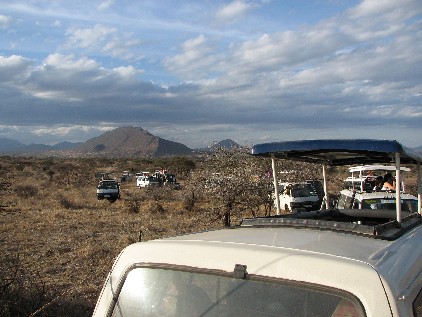
We spent roughly two and a half days in Amboseli National Reserve in south central Kenya, butting up against the border with Tanzania. Our initial reactions to the area were shock at the shear amount of environmental degradation present in what is considered one of Kenya's best parks. There is a tremendous amount of erosion across the landscape here in Amboseli. Caused by rising salinization (salt accumulation in the soil due to evaporation of water on the surface), damage caused by elephants, and safari vehicles creating their own paths, the resulting area is reminiscent of the American Dust Bowl in the 1930s (except with elephants and wildebeest to name a few).
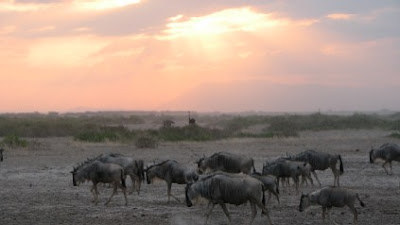
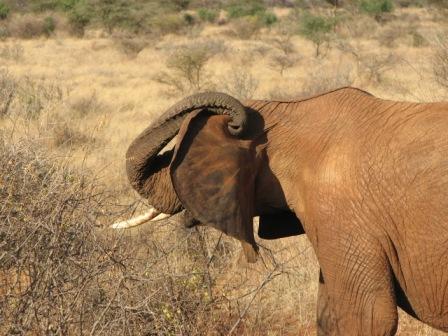
Dust literally covers most of everything here. In fact, the wildebeest look noticeable older (grayer) here than in "the Mara". Wildlife is not hard to spot moving even hundreds of meters away. All you need to do is follow the smoke trails whisping into the air like far off smoke signals saying, "Over here!". These gray clouds are choking the remaining grasses and it is assumed that their decline will cause most of the ungulates who rely on them to move on (but where?). We even saw an interesting elephant foraging strategy here. A juvenile female would dig the dying grass with the back of her front foot, then proceed to roll it into a ball using its trunk to blow the dust off of it before eventually popping it into its mouth. It was all very well choreographed. And in the afternoon when the winds blow stronger you can see thin twisters of the gray dust shoot into the sky. This situation demands attention, but at least on the surface it appears that attention is not forthcoming. Amboseli is a hard place.

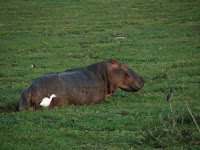
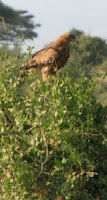
There is a large wetland system (Lake Amboseli & others) throughout the park. It takes up a rather large area during the rainy season and shrinks to a series of small pockets (swamps) during the dry months. Here is the best place to see wildlife galour of all shapes and sizes, colors, and adaptations. Wetlands are highly productive ecosystems capable of supplying sustenance and water to high numbers of resident and nomadic animals (including humans). Hippos graze through the muck, cattle egrets perched on their backs waiting for their free ride to turn something good up. Fish eagles, jacanas, plovers, wildebeest, cape buffaloes, elephants, and hundreds of other species rely on this area. Here, more than the surrounding areas, the web of life is solid and multifaceted, but it is only as resilient as the supply of water. This dwindling arc of life support is the hope of thousands of creatures for survival in this harsh, nebulous environment. In fact, a mountain across the political border with Tanzania largely determines the hydrological upkeep of the wetlands in Amboseli.
The water that supplies the wetlands here is heavily subsidized by snow melt from Mount Kilimanjaro which slowly makes it way through subterranean rivers, trickling out into this oasis. As many of you may already be aware, the amount of snow on Kilimanjaro has been steadily declining for at least the last thirty years. A simple math equation of annual accumulation minus annual melt off shows this trend year after year. There may even be a time when there is no snow garnishing the top of Africa's highest peak.


What is causing this to happen?, you might ask. Popular scientific thought is that the steady rising of earth's annual temperatures, global warming, is the cause. And as an extension of that, we as individuals, groups, companies, and nations are heavily subsidizing this effect. So, in essence, we are all involved (whether we like it or not, we have no choice) in the fate of the hundreds of species of wildlife that call Amboseli National Reserve home. Indeed, the web of life reaches everywhere.
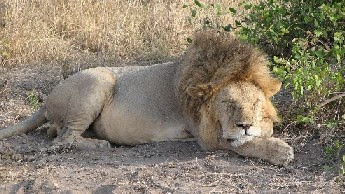
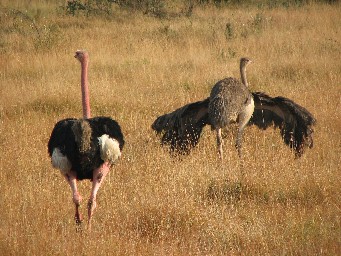
Nevertheless, over 350 bird species and 65 mammal species call Amboseli home. I could easily spend weeks here just looking for birds. My favorite for some reason it the Blacksmith Plover, a medium sized, black and white plover who boastfully walks by themselves or with a mate near the water's edge. We saw our first adult male lion, who at the time was courting a lovely lioness. Cats are cats across the board and do a very good job of laying around for long periods of time. Well, at least you can get great photos of them in action (or rather inaction).
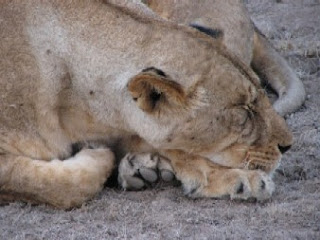


We also were fortunate enough to have witnessed an awesome ceremony performed by male elephants not even ten meters from our vehicle. We saw a large group of elephants headed towards one of the swamps - mothers, infants, toddlers, juveniles, and a couple of larger males. It was clear who was the dominant male in the group. He was huge and he was in must (sexually available). Surely his goal was of a romantic nature as he followed behind the group of females.
What proceeded was none other than a sizing up of potential suitors. You have to hand it to the smaller male because he had one huge set of proverbial tusks to stand up to the larger one. The encounter was rather gentle really. They would lock trunks slowly, push on each other, and do sort of swaying motions with tusks interlocked. But nothing violent was observed. It almost seemed like a friendly arm wrestling match between friends, although replace trunks and tusks for arms. They eventually sorted things out, the smaller one submitting himself to the larger one by turning around with his rear end exposed, and then continued on their way. Ask Jessica how many photos she took when you get a chance.
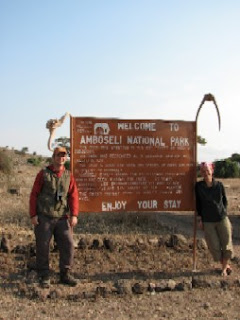

We said goodbye to Amboseli and headed back to Nairobi retracing the bumpy roads one by one. Our safari had come to a close and it was amazing. I encourage anyone in need of adventure to come and experience the ride of a lifetime.

There certainly is something magical and inspiring about the landscape in Amboseli. I challenge anyone to look at a sunset here and not claim it in their top five places to see the daily event. It is noticeably so old and weathered here yet so may animals continue to eke out an existence, weaving their way through the ropes in the web, relying on the connections between each other.


It is reassuring that even in the face of hardship life is resilient.


Sunday, August 12, 2007

On the Move: On the heels of the Wildebeest in the Maasai Mara

There is not much else more iconic than a trip to the Masai Mara...the migration of tens of thousands of Wildebeest, Zebra, predators in tow and the famed Masai herdsmen, long and thin, draped in red blankets looking after herds of cattle and goats. It would be hard for someone to come away disappointed in this amazing environment with its tumultuous past and rather tentative future. Ben and I were lucky enough to arrive during peak migration of Wildebeest (and tourist alike).


We arrived for an afternoon game drive leading from the front gate to our campsite. The first thing that struck me was the enormity of the area.. it is massive, sprawling, the golden-brown tones of a large grass savanna seemed to spread over the hills for miles and miles. It was the stereotypical African environment: Acacia trees, golden grasses and red hot sunsets. The stuff that inspired Karen von Blixen-Finecke to write "Out of Africa," the amazing and exotic environment that drew the big game hunters "Out of Europe." The only difference I saw after crossing into the Masai Mara Game Reserve from the hours of driving to get here was there were no Masai or their Brahma-style cattle. I also noticed that I did not spot a single animal beast or bird.... strange. Okay maybe not so strange just a bit naive that the whole place would be filled to capacity with National Geographic-like adventure.

Now I called it a "game drive" and that is just what they are. Most East African parks, particularly those in Kenya or the massive Mara-Serengeti savanna ecosystem, are strictly to be explored within the confines of a vehicle. No getting out, no excuses. The immense spaces and not to mention the wildlife (particularly those meat eaters) are not domesticated in any way shape or form. Yes they may watch you carefully and with little interest in those all so common big white safari vans but there are accidents every year and people die... they are trampled, mangled or eaten. I have a healthy respect for the rules, so as much as you want to pull a Julie Andrews and spread you arms and run singing through the rolling hills.. you don't.

So the first sign of wildlife in the Mara was proceeded by the smell. We though yes, I know that smell, musky large, leathery elephant smell. And sure enough there was a small herd of elephants, about 3 adult females, their juveniles and a few rather young, still nursing, calves. They were amazing and our driver put us very close to the action. I often felt a bit too close and intrusive, yet these lumbering giants continued to forage and eat as if several white safari buses were part of the mundane scenery of "Great Migration" of July and August. They were amazing never the less and approached the vehicles in close proximity, to the delight of many tourist albeit two who always remained a bit anxious due to the immense respect we have for the absolute power and wildness of these magnificent creatures. Ben and I often were the ones yelling: "Stop, Stop.. Sawa sawa (okay), that is close enough!" (although sometimes to the bitter disappointment of those traveling with us).
We continued on, although you could watch the elephants for as long as you desired, as they seemed in no hurry to move on to the next group of gawking tourist. We starting seeing evidence of ungulate life in the savanna, a zebra or twenty here, an impala or Thompson's gazelle over there, when we were lucky enough to get an early reminder of why you should remain in the car- a pride of lions sleeping on a large-sun heating rock, waiting for the sun to fall beneath the hills and instigate the night-time hunt. I was very pleased to note that their rock was about 15 meters from the road, giving them a bit of a buffer against the snapping of cameras and pointing of fingers. The pride consisted of about 4 adult females and what appeared to be a rather young male, his mane not quite full and long but more like a motley crew cut with a week of growth. He sat up and looked around a bit, almost off in the distance and when a female stirred awake they looked at each other briefly and she laid back down. Our guide was explaining to us how the female lions have a longer lifespan than the males and he added a comment to the effect of it being due to their indolent behavior. Probably also has to do with the fierce competition between males.... the old man will eventually lose his pride to the younger, stronger and more fit sophomoric one. Could help but wonder if that was the case with our young male here?
The next day we spent the entire day on game drive, only stopping once to view the Mara River, a hippopotamus laden, crocodile sprinkled, muddy waterway, that if you are very lucky you will see the crossing of the Wildebeest. There was also a troop of Black-faced vervet monkeys that hang around tourist areas hoping to steal a bit of food. Hippos lounged on the opposite mud-bank of the Mara although occasionally a bit of a tiff would break out and demonstrate that indeed these animals could efficiently move their bulk. The armed guard, which you tip and was the source of a debate in the vehicle (need them or not), took us to the vantage point where you could look at the Wildebeest that had yet to cross the Mara River. The guard told us that at various times they will cross for about 2-3 hours straight and then stop for an unspecified amount of time until they resume again. Not all Wildebeest migrate, in fact there are even some within the Mara Reserve that are year long residents. The same can be said to be true on the other side of the border, where the Tanzania's Serengeti National Park joins the Mara.

The environment, despite straddling two national borders and three different management regimes, forms a rather continuous piece of conservation area with animals (hypothetically?) being able to migrate between three different reserves: The Masai Mara Reserve (Kenya), Serengeti National Park (Tanzania) and Ngorongoro Conservation Area (Tanzania). Three different management models, similar and yet differing histories, all within the Masai traditional boundaries and all very interesting from both an anthropological and natural resource perspectives. In short the "Mara" is not managed by the Kenyan Wildlife Service but instead is managed by a Community -Based Organization (CBO) on behalf of the Masai themselves. It was extremely hard to find more information on the history of this area, the structure and politics of profit sharing and/ or how the management plan incorporates the larger Masai community....all things to be explored later? I am on vacation after all! (This is however a field of inquiry that I will hopefully be exploring in graduate school- human ecology and conservation areas management).

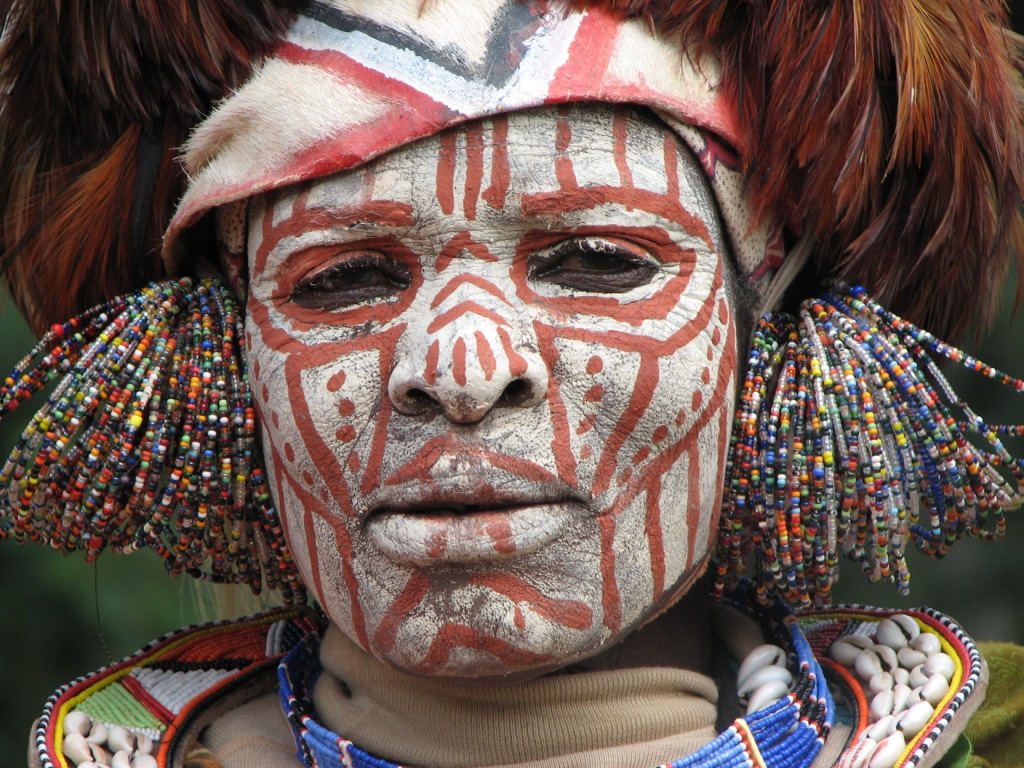
And of the Masai themselves? Well, I did go visit one of the tourist "villages" paying a bit more than 10USD for unlimited photographic opportunities, got to see "customary dances," go into a Masai house and try some of the sausage-tree home brew. A cultural sell-out? Cultural tourism? Cultural preservation and profit? I really don't know how I felt about what I saw and I would encourage others to reserve harsh or quick and easy judgements as well. One fact is true: for many a decades in Kenya and Tanzania the image of the Masai was used to sell the country, becoming the picture of tribal East Africa, and the Masai themselves didn't benefit at all. Could you really blame them now for being aggressively adamant to receive a few shillings to take their picture? Can you imagine what it was like to see your image in magazines, pamphlets and books to advertise tourism for which you not only didn't profit but actually lost land and resource access to create?


At least in these "villages" the Masai have some command and control over their image, their culture and profits. They also are able to minimize the effect of tourist on other villages or homesteads by herding the mzungu (along with their cattle and goats) into one concentrated area. I heard many a complaint by tourist about the authenticity or wanting access to a "real village." All these complaints seem a bit ego-centric to me (particularly considering most of these people would role their eyes and yet go inside and take photographs.. all the while feeling sorry and embarrassed for the villagers...hmm). Cultural tourism is tricky, the effects can be complicated and represent a matrix of beneficial and disadvantageous effects and may preserve or distort the culture participating. I believe that people should avoid quick and rash judgments on such matters (or if they disagree...stick to your guns and don't go or support the venture!). Anyone who has ever gone to a Hawaiian luau, an Amish village or Native American Reservation probably has had a few of these conflicting thoughts in the back of their minds. Are we celebrating the cultural diversity or destroying it with our capitalistic purchase of its performance?


Either way the Masai are a dominating force when it comes to the image of East Africa and here is the real kicker... they only make up about 5% of the population of the hundreds of tribes in the area. According to many of the other residence (such as Kikuyu, making up 20% of the ethnic population of Kenya) the Masai are famous because they have refused to let go of their culture, their customs and integrate into the larger monoculture of Kenya, more so than other groups. It not that some of the Masai don't wear modern clothes, shoes or haven't lost many or their customs, because indeed some have, yet many have not and many more live somewhere in the middle. I guess the one instance that demonstrated this more to me than any else was the short road stop we made in the middle of Masai country. Three Masai boys, leaving their livestock for a moment, came running up to the van, amazingly just to peer into the group of strange people inside. Going on the material alone (dangerous but lets go with it) they represented a spectrum of Masai-dom: one was completely traditionally dressed, one had a pair of shorts a t-shirt and then the Masai blanket draped over his shoulders and the eldest was dressed in completely western attire down to his sneakers. All were Masai however. All of them carried implements of a herder, all spoke the same language and all were performing the most important task of a Masai... looking after their cattle.
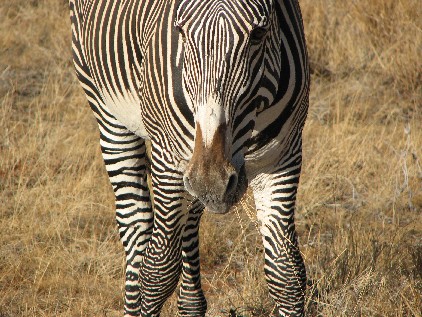
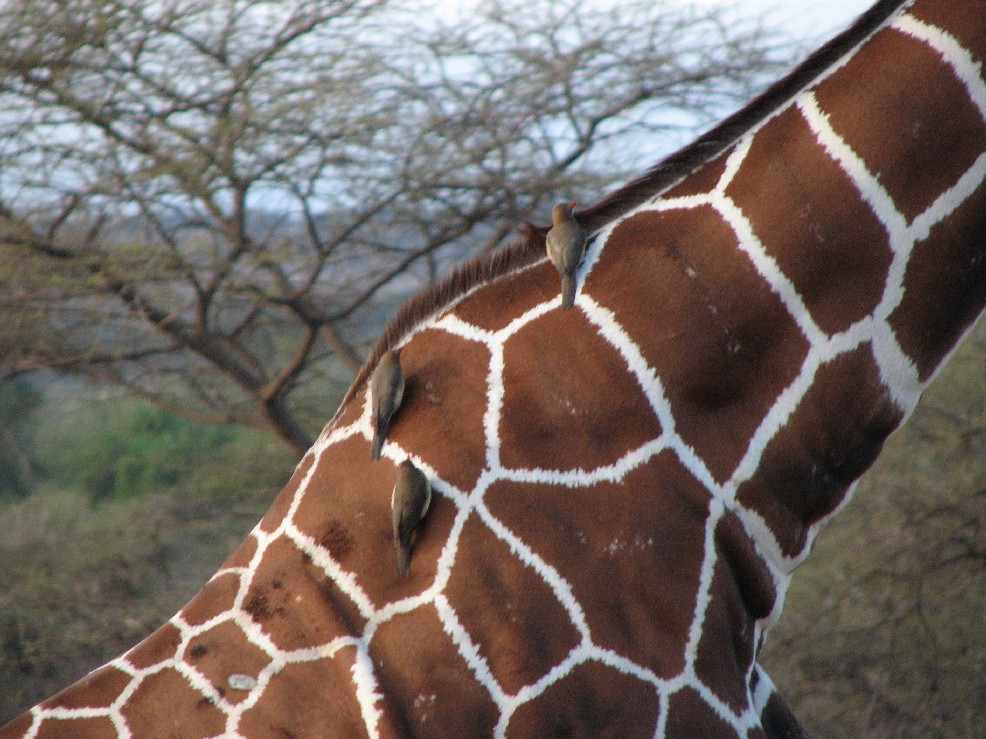
The Mara was not disappointing in the least, not on a superficial level or an intellectual one. We saw so many animals in this park, lions, cheetahs, a jackal, vultures, zebra, cape buffalo, giraffe, a tone of different antelope and birds. One of the most interesting things to watch was a group of Maribou Storks and various vultures posturing and picking the remains of a dead cape buffalo, which we returned to several times during the day: Nature sure has efficient waste management or more accurately, in this system nothing is wasted. The amazing landscape, animals, people, conflicts and history are shrouded in mystery and myth, compromise and harsh reality. I certainly came away with more questions than answers and a powerful imagery of a place that deserves to be one of the seven natural wonders of the world.

-Jessica

Pretty in Pink: Lake Nakuru National Park

So the blog is a bit out of order, but my fond memories of Lake Nakuru National Park have made me jump a bit in the chronological order of our safari. So Lake Nakuru NP is a soda lake, meaning it has alkaline waters, which nourishes the both blue-green algae and a particular group of crustaceans. Now if you are not impressed yet with the lake's greenish slug the two particular animals after this rather interesting mix is the greater and lesser flamingos. There are not just a few flamingos but rather tens of thousands, at any given time, like lawn ornaments gone hostel guarding the lake. Well, okay they don't guard so well and you can easily set a hundred a flight by approaching to closely.

We only had half a day in this park, which is much smaller than the Maasai Mara but I felt I could have spent days. The park also boast some rather lazy white rhinos, which were reintroduced many years ago, and some rare tree climbing lions. We actually saw the lions, about six, including a cub in the trees sleeping as we left the park. The park also has it share of Africana icons: giraffes (although a different subspecies), warthogs, cape buffalo, baboons, waterbuck, gazelle and the like. We actually saw in great number here one the smallest of the antelope species, Kirk's Dik Dik. Name aside it is a delicate little creature and looks more like something out of fiction book with its funny little nose and unimposing horns. For anyone a fan of miniatures... this is your antelope.

So when we first arrived at the lake we were a bit lucky, only a couple vans with Japanese tourist all of which had cameras and lenses that made me flush green with envy. Ben immediately took up the bird watching campaign as there is more than the hoard of flamingos in the park and I wondered off along the edge of the lake and peered into the sea of pink. My lens-envy aside no digital or analogue apparatus could render this lake as beautiful as it was there in full panorama, surround sound and the pungent smell of bird in the air. Ben and I had to be hauled back in the vehicle for a drive up to the Baboon Cliff lookout. The drive was pleasant because we had beaten the large drove of vehicle that were just now pulling up to spoil all the Japanese photographers. Our lone vehicle pulled up to a spotted hyaena munching down on something a Marabou Stork voraciously looking on for scraps. Was that a pink feather I saw?

The question was quickly answered as we spot another hyaena running confidently but with not too much haste into a crowd of flamingos. Our driver said they often do that and look for the ones unable to take flight. So there we were less than 100 yards from the hunt and we watched how the hyaena turned, reassessed and rather easily came out of the shallows of the lake with a bright pink prey in his mouth. Okay so some of you don't enjoy nature's carnage but these displays are the best in terms of wildlife viewing. That life ya know... birds gotta fly and hyaenas gotta eat. Maybe we could change the phrase from "Like a sitting duck," to "Like an elegantly standing flamingo?" Doesn't have the same ring.

We headed up to Baboon Cliff and kept our eyes unsuccessfully pealed for a leopard. The view from the top was simply amazing. You see the lake below, the flamingos look like a mirage of pink in the distance, with the occasional cape buffalo or rhino dreamily strolling along the waters edge. Ben and I wanted to see a Rock Hyrax, which is a small ungulate (stomach like a cow) that actually looks like an overgrown ginea pig, and we found a small den, the rather pungent evidence of their inhabitation left in neat pellet like piles by their front entrance, but no Hyrax.


Well the park's history, like many in East Africa is all pink and furry like we would all like to believe. The park covers about 180 square kilometers and since its creation in 1961 has experienced multiple crashes and recoveries in the flamingo population due to the erratic water levels in the lake. The parks 1st birthday was actually sullied by the fact that the lake completely dried up! And heavy rains which diluted the alkalinity also caused another flamingo crash and mass exodus in the 1970s. More recent management woes have been pollution from Nakuru town, pesticide runoff from the matrix of farms in the area and large scale deforestation in the surrounding watershed. The World Wildlife Fund (WWF) has stepped in with efforts to combat these modern day realities, particularly by the replanting of saplings in the watershed. Like everything though, the wild corners left will depend as much or more on managing people as the wildlife itself.


Ben and I left, our necks straining to get the last looks at the park. Although I have long had an aversion of pink, with all its gender-heavy hues, I must admit Lake Nakuru really makes pink look good.

-Jessica

Thursday, August 9, 2007

Nairobi Reformed?

Well having spent more than a couple days of our Kenyan experience in Nairobi it got me thinking: Is "Nairobbery" up to par with its reputation? I believe that the answer is definitely "maybe." The rumor and volunteer mill puts this urban population at around 3.4 million people although we have found downtown Nairobi to be much smaller than would be expected for this populous. Kenyans are adamant that the new government has certainly greatly improved the situation in Nairobi, particularly within the City Center area, and evidence of this is everywhere. Security and police forces are found on every block and are hard to miss nonchalantly carrying Russian assault rifles. I am also told that there are a great deal of police dressed in street clothes. I hardly feel though that the city deserves, what some travelers and guides have given it, the reputation as "the most unsafe city in all of Africa." Don't get me wrong.... the place can feel a bit concerning. Ben and I have been careful of our belongings and haven't ventured out after dark. Would "street-smart" be a necessary thing to pack when coming to Kenya? Yes.
Well what is Nairobi like then?..... It has the hues and feel of architecture from the 1970's. Unlike many large cities I would say that, barring the natural diversity of the tribal Kenyans themselves, the city is very African... not many wazungu (white people) and just a dash of Indian-ex-pats. Vendors here are aggressive, the bartering is harsh and there are just about two menus or prices for anything that doesn't have a bar-code. (Mzungu prices can be 2-5 times that of a local...a bit frustrating.) Thing to know... nothing here in Kenya is free. Nothing. An example is a local shop keeper that tried to sell Ben and I an old-beaten up cardboard box for 400 Kenyan shillings (nearly $6). We walked away and got another young man to give us one for the price of a soda (50 Ksh). The city does have its charm and so do the Kenyans. They are very political and away of global events and you can have some very friendly debates without risking the loss of a friendly handshake at the end. You can't really blame the people here for having an angle or for competing aggressively for business... life is hard and there is a lot of competition.
Here is a small bit of Nairobi history: almost everything here is less than 100 years old and prior to 1890 was little more than a swamp land with a stream known by the Maasai as "waso nairobi" (cold water). With railways coming onto the African seen the East African railway's company Uganda Railway further developed the area by putting an administrative center here. Nairobi's fate was sealed when the British Protectorate moved their capital from Mombasa to Nairobi in 1901. Even as "permanent structures" went up the town had a different kind of wildlife, as compared to the contemporary night scene, with a lot of wild animals roaming the streets and avenues. Then comes the Hemingway age... the hotels that the British built in the early 1900's catered to the big game hunters that would eventually lead to the crash of the mighty iconic wildlife of the area. The building you see today, like I said think 1970, were build over the demolished colonial ones after independence in 1963. They are mostly bland and boxish.
Moving away from the City Center of Nairobi and common to many other towns in Kenya are rather unfortunate in terms of sanitation and infrastructure. However all are bustling with activity and there are a myriad of bicycles, donkeys and carts, cattle, goats, herders, pedestrians and street vendors to liven the scene up. Some of the architecture found in the outer villages and towns are really quite beautiful. Many homes and building are made with stone bricks that are cut by hand. The shops and street malls created out of these stones will be about two stories and four stores long, all brightly painted with advertisements like NesCafe, Safaris.com or Selcom (cellular phones). It is actually visually more pleasing than the alternative of having roads lined with billboards.
Well I will let you go from there so I can get to the good stuff... the safari, the history, the scenery and the adventure that is Africa!
-Jessica

Thursday, July 26, 2007

Underwater in Vanuatu

I have spent a good deal of time in the rich marine waters of Vanuatu. For a small volcanic island archipelago, the marine environment is one of the richest in terms of biodiversity and shear abundance of wild organisms as much of the terrestrial environment, particularly many of the vertebrates and plants, were transported along with their human counterparts all those years ago on voyaging canoes. As far as mammals go in Vanuatu, the flying fox with about 3-4 species and a few species of bat are just about as naturally occurring as it gets, the remaining mammals are cows, pigs, goats, dogs, cats and of course the omnipresent rats and mice (in differing varieties according to their human navigators- so they are a blend of European and Asiatic descent). There is however a high level of endomism (species occurring and evolving only in Vanuatu) among plants, reptile and avian species. Much more difficult to detect would be endomism in the marine environment, although I have no doubt Vanuatu holds unique treasures in that area as well. So I thought I would do a quick blog to introduce all of my land-loving friends and family to the tropical marine environment. As I generally taught this to incoming new volunteers in Vanuatu... I shall cheat and use many of the same lessons that I had in the past. This also gives me a chance to put a great amount of my underwater photos on-line of which I am generally proud (So prepare yourselves for a lot of photos and little substance).

First and foremost.... the base of the one of the most biologically rich ecosystems in the world... what the heck is coral anyway? Well coral is a symbiotic relationship between a minute (in most cases) animal called a coral polyp and an algae called zooanthellae. This symbiotic algae, that lives within the polyp’s tissue, provides the vast majority of the nourishment required by the polyp and subsequently also provides the coloration. These polyps live together in a colony or what we recognize as a coral. There are hundreds (possibly thousands) of species of coral, most of which are difficult to identify in the field and require microscopic analysis to properly identify at the species level. There are two loose and broad categories in which you can classify corals: hard or soft. In the case of hard corals they secrete calcium carbonate and actually live on top of this limestone secretion. Hard corals are important because they build the overall structure of coral reefs through the process of secreting calcium carbonate. This structure may be colonized by future coral polyps or by other coral reef organisms. Soft corals excrete a common skin rather than a hard skeleton and can extensively grow on all reef system, coming the most abundant in 10-30 meters of depth. They are important food sources on reefs and potential source of wonder drugs.

Due to the fact that corals are not only a living organism but also are a result of an unusual relationship between an animal, polyp, and an algae called zooanthellae there are many things that can damage corals, killing the coral polyps or destroying the entire colony. Corals face both human and natural impacts and damaging events. Some of the natural events and predation that corals face are:
  • Cyclones or strong wave or tide surges
  • Predation by fish or organisms that consume polyps or zooanthellae (such as Parrot fishes which eat hard corals and "poo" the nice white sand beaches everyone lays on)
  • Seismic activities such as earthquakes or underwater volcanoes
  • Freshwater run-off
  • Algal blooms
  • Introduced or invasive species
  • Coral diseases
It is important to remember that like all ecosystem coral reefs are dynamic systems with periodic disturbance. Human impacts, however tend to be chronic and not allow a recovery period. Human disturbances often may exacerbate natural ecosystem disturbances and may slow or halt coral reef recovery. Such human impacts include (but are not limited to) some of the following... remember to that I tailored this presentation to Vanuatu:
  • Over harvesting of fish or invertebrates which clean or glean the reef: this includes the Aquarium Fish Trade (also worth mentioning in point two).
  • Predatory release is another issue when a given animal is over-harvested and this allows its prey to "release" or become very numerous... an possible example of this is the Crown-of-Thorns Starfish which eats coral reefs at an astonishing rate which is in turn eaten by the Triton Trumpet Shell (sold at markets for the curio trade).
  • Using fish poisons (cyanide or customary) which kills coral polyps
  • Reef Gleaning- walking on the reef to collect shells or invertebrates
  • Inappropriate or damaging fishing practices such as dynamite or nets that drag the bottom
  • Sedimentation or run-off from erosion or agricultural land
  • Pollution (solid waste or industrial run-off)
  • Global warming- which is being very closely monitored here in Vanuatu and causes the corals to stress, the polyps expel their zooanthellae and become "bleached." A coral that has bleached is essentially starving and has about 2 weeks to regain the photosynthetic zooanthellae.
Of course I guess some could say, "Who cares about coral reefs?" The answers are many and you can take your pick between the down right conservation minded to the straight laced economically motivated. Here are a few that I often teach during my Reef Check trainings:
•Home to 25% of all marine fish and is required during the breeding times of numerous others.
•Support tourist economies, especially with over 20 million scuba divers in the waters around the world.
•A source of drugs for medical use (did you know that coral calcium can be used in bone graphing and to replace eye balls!)
•Food source for 300 million people worldwide and most of the coastal villages of Vanuatu.
•Coastal protection from wave erosion, hurricanes and tidal waves.
•Important to local and international cash economies of many nations, including Vanuatu.

In Vanuatu coral reefs and the inshore coastal areas are important in so many ways, with many communities in Vanuatu relying heavily on inshore or coastal fisheries which are accessible to men, women, boys and girls on almost a daily basis. In Vanuatu, coral reefs form the basis of the subsistence, local market and export (trochus) opportunities for many rural Ni-Vanuatu.

Culturally customary marine tenure plays a vital role in the management of coral reefs and also the harvesting and processing techniques with men, women and youth each have role to play in harvesting resources from coral reefs. Having lived in Vanuatu for three years, few things surprise me anymore in regards to what is considered edible and not edible from the sea... anyone having spent much time in Asia will not find this very shocking. In Vanuatu people of course eat fish, numerous invertebrates (such as shells, lobsters and crabs) but also things like sea urchins, sea stars and the palolo worm or "nawel" as we call in Vanuatu. The "nawel" is a rather small, high "crunch" to meat ratio worm, that spawns and becomes plentiful only once or twice a year at the new moon in October. I shall struggle to remain completely culturally sensitive and not comment on the taste.
However these diverse ecosystems, coral reefs which rival rainforest's diversity, is not just about fish and coral. There is a vast array of different life forms, functions and proliferation in the marine waters around the world. Here are a couple major categories:

We start with Cnidarians (the stingers): Corals are Cnidarians. Coral growth forms may vary according to species, wave action, availability of light or disturbance regime. Common growth forms include; boulder, table, digitate, encrusting, foliose or mushroom. This remarkably diverse group includes jellyfish, hard and soft corals, gorgonian fans and sea whips, hydroids and anemones. Many contain stinging cells called nematocysts and some are deadly!

Marine Plants are the basis of the marine and terrestrial food web, these primary producers range from microscopic to higher plants such as mangroves. There are two basic types; 1.marine algae, and 2. sea grasses and mangroves.

Sponges have the least complex body structure of all multi-celled creatures and are the reefs vacuum cleaners, filtering out bacteria and organic debris. While natural in a reef system, an overabundance generally indicates sewage or pollution, ie.... stinky, gross water!

Marine worms are diverse and there are thousands of species found in amazing array of habitats and four major groups; flatworms, polychaete worms, Ribbon worms and Acorn worms. Two popular varieties for divers are flatworms and Christmas tree worms. Christmas tree worms are found on boulder corals, and will suddenly vanish if you come too close. Flatworms are easily confused with Nudibranchs but pretty much just as cool. Christmas tree worms actually bore into the coral calcium and I believe using a bio-chemical process and they are very colorful.

Nudibranchs (literally meaning "nude lung") and Sea Slugs are easily confused with flatworms, however these tiny colorful creatures are actually related to Mollusks (snails), the most colorful and attractive being the Nudibranch group. The majority feed on algae, sponges and some cnidarians. One Ni-Vanuatu Scuba-diving Reef Checker I trained in Santo became quite obsessed with Nudibranchs once she noticed their existence on the reef and gave me a bit of exercise because she wanted me to photograph and look at everyone she found!

Mollusks and Bivalves comprise one of the largest divisions in the entire animal kingdom with over 100,000 species represented worldwide. This group is extremely important in terms of subsistence as well as economically valuable as it includes bivalve shells such as oysters, shells sold for curio trade (such as the triton trumpet shell), trochus (which are used to make buttons) and giant clams (both consumed and sold to aquarium trade). Many of the animals are endangered and some are very dangerous, containing some of the most powerful neurotoxin in the world.

Cephalopods are a major subdivision of the mollusk family and comprise of octopus, cuttlefish, squids and the nautilus. Many live in the open ocean or deep waters around the world but some species such as octopus are found in coral reef areas and are important predators as well as prey for hungry humans. Between 650-700 species of cephalopods have been documented worldwide but the group remains one of the most mysterious with new information being found every year.

Crustaceans are the most dominant group by far found on the reef systems with over 30,000 species worldwide, many of which are economically important and just down right tasty! The crabs, shrimps, lobsters and numerous microscopic organisms, which often are an important ecological food base, are related to land-loving Anthropoda which includes land insects, spiders and scorpions. In Vanuatu this group is very important for both local food (often served in coconut milk) and for local markets in Vila and Luganville. Traditionally there were some species reserved only for consumption by chiefs.

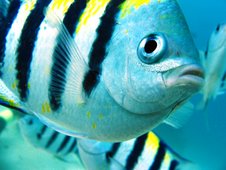
The Marine Fishes are the iconic and often most conspicuous animals found on the reef and with nearly 7,000 species of the world wide 12,000 found on coral reefs or near shore areas, this is ecologically and economically an important group on Vanuatu's reefs. Approximately 638 species of fish associated with coral reefs alone have been documented in Vanuatu and many or these are consumed locally or sold to local and overseas markets. Coral reefs are also important nursery grounds for many transient or migrating species often sought after by fishing vessels such as tunas, trevally and sardines. In Vanuatu many coastal communities have specific names for each species in local language and sometimes may have different names for juveniles or male and female of one particular species!

Marine Reptiles includes sea snakes, with nearly 50 species worldwide, and turtles the ancient lineage which is nearly 150 million years old. The sea snake is differentiated from the eels by distinct scales and lack of gills. Sea snakes may be extremely poisonous although non-aggressive. All species of turtles are considered threatened or endangered internationally but yet are still killed for certain ceremonies and consumed for subsistence purposes in Vanuatu.

Marine mammals, such as dolphin or porpoises, dugong and their relative in the Atlantic the manatee, are found in warm tropical seas. The dolphin or porpoises are rarely spotted near shore while the dugong often feeds on near shore sea grass beds and is totally protected under Fisheries Laws of Vanuatu. Whales may also venture into Vanuatu's waters during the winter months of the temperate zones.

Marine birds are also important within the coral reef and near shore ecosystems as they are predators and natural reef gleaners. Many consume crabs, bivalves, micro-crustaceans, fish, baby turtles and eggs.

Humans in almost all coastal areas worldwide serve as a mega-predator and may have large impacts structurally and ecologically on coral reef ecosystems! Humans are one of the few animals that have the capacity to change their ecological relationship in the coral reef systems as well and need to constantly adapt, monitor and manage themselves in regards to this delicate system in order to maintain healthy coral reefs for future generations. Check out the link on the right for Reef Check International for more information on coral reefs worldwide.

-Jessica

Waffle wrapped Hot Dogs

So this is the last short note from the Kingdom of Thailand. A couple short thoughts since the last blog: You know how I said you can buy almost anything in Thailand.. particularly Bangkok... the photo to the left is a fuzzy little example of this that was on sale at the night market in Kachanaburi. Nice dress. Enough said. Of course Ben and I have been combing the city to find what we thought would be a simple enough quest: a raincoat for Ben. Didn't really need or want a furry bunny in a dress or a T-shirt with a man on a toilet with an I-Pod that says "I-Pood." Well we found one today, so all the moms can stop worrying, but it was the hardest purchase that we have made here in Thailand.

Ironically it has been raining here in the Kingdom, not often but with a certain fury when it does. As Ben and I just made it to the Indian Embassy to pick up our visas the skies opened and poured forth a mess that apparently was a bit much for the gutters to handle. Ben and I were left with the choice of soaking shoes or a small block of turf out front of the embassy to walk on. The whole thing got me thinking about those alternating sweat and sewage smells so prevalent in Thailand...Ben said he would just remove his shoes and wade across to get some coffee across the street. A small argument ensued, which I won (probably due to the fact that if lost he would spend the evening in an extremely small hotel room with a grumpy wife), with my not so meekly put point which was... this is Bangkok not the bush in Vanuatu! You have seen the streets and you are not walking barefoot through god knows what to cut your feet and get some strange infection!

I guess the fun thing about traveling is that you never know what the fun bit of strangeness will come your way. For instance, waffles are apparently a big thing here with street vendors selling them with a variety of sweets and toppings. I decided that I would purchase a "waffle on a stick" at the night market in Kanchanaburi. As I enjoyed what I thought would be a familiar taste I bit into a hot dog in the middle. Ben chuckled and asked how it was... I replied, still eating..."Taste like a hot dog with a waffle wrapped around it." Next post... Kenya.


-Jessica

Sunday, July 22, 2007

River-side by the Kwai

Leaving Vanuatu was difficult even though both Benjamin and I were utterly exhausted by work and in dire need of a break. In many aspects I am not sure that it has really sunk in that we are not returning... I mean we have come to Thailand before and enjoyed cuisine that tasted very different than starch, coconuts and firewood and yet returned to our island home. So it will take a several months I believe before it sinks in that our adventures in Vanuatu are behind us and many other adventures lie ahead. One thing is for certain, leaving the quite small capital of Port Vila and landing, after 28 hours of flights and lay-overs, in Bangkok a city of 10 million people and a sensory overload of lights, sights, smells, colors and languages, is a bit shocking really.

Ah, yes Bangkok. You can buy anything and everything in Bangkok. Benign and any sort of debauchery you like is all laid out in front of you for your bargaining pleasure. Many of the goods just leave me wondering, after having a bit of experience in manufacturing; Did someone really create a mold or fitting to create that? Who is the poor soul that sets in a factory all day and creates these smiling, ceramic and rhythmically waving cats? Coming from our small and rather socialistic South Pacific home I find it hard to look around and see the huge disparity between the Thai and I find it rather hard to witness the homelessness, poverty, hunger and begging women and children that were absent in Vanuatu. It seems to me that Bangkok is a concrete jungle, a complex maize of facades built one in front of the other. Unlike many countries, such as our own, Thailand makes no effort to cover up the disparity, the old or unpleasant facades and they exist side by side with the new, glamorous, high technology and consumer driven facades that the upper-class Thai enjoy. Case in point was the small toddler we past on the "sky deck walkway" walking from one designer mega-mall to the next. There was a row of street beggars only 20 yards from the entrance and the last one was a 2-3 year old sitting by himself, no shoes, no shirt, repetitively and almost trance-like performing the wai (hands in prayer-like gesture) and bowing over a small cup of change. Only 20 yards away were the marble-clad corridors full of Thai people purchasing Prada and the like. A security guard also stood by the door, in full view of the street peddlers and beggars... no attempt was made to relocate the powerful illustration of social class here in Thailand.
There is one thing to be said about Bangkok and that is they have plenty of coffee-houses much to the delight of two Kahlers very sick of being served instant Nes-cafe for two dollars a cup in Vanuatu. Shaming enough Ben and I were "those Americans" for a few days, dabbling into a bit of McDonald's, Starbucks, Pizza Hut, Subway and Dunkin Donuts. The only excuse I have is that it had been nearly a year since we had any heart clogging, preservative ridden and entirely inorganic Americana. We have since settled into a bit of a quasi-local-American cuisine... a bit of Pad Thai and a Coke.. that sort of thing. Local whiskey (I think) and 7-up... everyone has to have a vice.


The noise, commotion, smog and cost of the capital city caused us to seek refuge in a smaller town. So Saturday we headed for Kanchanaburi, a "small" town of around 60,000 plus people, and home to the historical Bridge over the River Kwai. The bridge was completed as part of the infamous Death Railway to Burma during the second world war by the Japanese Army during their occupation of Thailand in 1942-43. The Japanese used POWs and labourers from Thailand, Myanmar, Malaysia and Indonesia to construct not only the bridge but nearly 415 km of railway to link Myanmar (Burma) to Thailand... a road to further imperial conquest. The labor which was estimated to take nearly 5 years by Japanese engineers was forced to completion in just 16 months at a great cost in lives; 16,000 prisoners of war and between 90,000-100,000 laborers. Only 20 months later the Allied forces bombed the bridge in 1945 and only fractions of the original steel bridge remain. Today the railway, although almost all the original work has been replaced, is still operational. Today it is also crawling with tourist. Oddly enough the Japanese flag is always hung prominently in the middle of many flags representing the war at the various museums and roadside stands... and they also have several memorials constructed by the Japanese... although who they are commemorating was a bit unsure.

Kanchanabari is a beautiful area and home to once mighty rain forest. It is hard to imagine what the POWs and labourers would have faced in light of the modern- and certainly more anthropogenic landscape found here today. Now most of the wildlife seems to be controlled and contained performing for tourist and Thai alike. At our guest house their are no fewer than three advertisements that would cause eco-friendly tourist to raise their eyebrows: a "tiger temple" complete with chained magnificent giants for your petting pleasure, a "monkey school" in which you can watch the trained monkeys perform human antics and the ever popular elephant ride through the forest. The first two are completely out of the question for yours truly and the third should only be done with the most reputable and conservation minded tour operators.

Considering what an icon the elephant is here in Thailand and the posh and gentle treatment received by most house pets, it is disturbing to see what these magnificent creatures face today. I guess like many other "unemployed" Thai the change in work brought about vast changes in lifestyle as well. Historically the Thai have used elephants extensively in agriculture, particularly forestry and even battle. However in the 1990's forestry was banned in the Kingdom of Thailand and many elephants and their human caretakers or "mahouts" were left unemployed. They turned to tourism to regain a living and a salary. However, tourism can is a tricky business and local people and elephants alike may either benefit or be exploited by this temperamental industry. The problem is that tourism depends heavily on responsible and conscious consumers that insist on high standards of humane and fair treatment of both humans involved and their animal counterparts. As Ben and I crossed the Bridge over the River Kwai we saw both examples of Thai humanity and kindness towards animals and their exploitation. A young elephant was chained near a group of stalls, swaying rhythmically, stereotypically and simultaneously pulling at the source of his confinement. Ben and I observed him for sometime, imagining how the Kanchanaburi forest before would have supported this intelligent and sentient creatures unchained wanderings. It was depressing and as we turned to leave we see a Thai women in the River Kwai gently and yet vigorously washing her plump dog as a parent would wash their child. The dog wasn't resisting much as it seemed this was probably not an uncommon ritual. Coming from Vanuatu, in which the washing of any animal draws a crowd of snickering locals, the humane treatment of particularly cats and dogs is a welcome relief.


It is hard to watch the sufferings of any being, human or otherwise. Many of the hardships and misgivings I may have about the situations found here in Thailand must also be viewed through diverse cultural glasses. The answers are not well defined or clear-cut. Tourism will not stop here in Thailand or elsewhere no matter the consequences for the environment or culture that draws people near. You can only support the most sustainable and humane options available and encourage others to do the same. One thing is for sure it is hard not to feel alive in this diverse landscape with the all the success and failures, the humanity and cruelty and the almost palatable optimism in Thailand's future.


-Jessica