Showing posts with label Vanuatu. Show all posts

Thursday, July 26, 2007

Underwater in Vanuatu

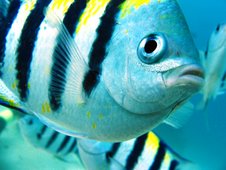
I have spent a good deal of time in the rich marine waters of Vanuatu. For a small volcanic island archipelago, the marine environment is one of the richest in terms of biodiversity and shear abundance of wild organisms as much of the terrestrial environment, particularly many of the vertebrates and plants, were transported along with their human counterparts all those years ago on voyaging canoes. As far as mammals go in Vanuatu, the flying fox with about 3-4 species and a few species of bat are just about as naturally occurring as it gets, the remaining mammals are cows, pigs, goats, dogs, cats and of course the omnipresent rats and mice (in differing varieties according to their human navigators- so they are a blend of European and Asiatic descent). There is however a high level of endomism (species occurring and evolving only in Vanuatu) among plants, reptile and avian species. Much more difficult to detect would be endomism in the marine environment, although I have no doubt Vanuatu holds unique treasures in that area as well. So I thought I would do a quick blog to introduce all of my land-loving friends and family to the tropical marine environment. As I generally taught this to incoming new volunteers in Vanuatu... I shall cheat and use many of the same lessons that I had in the past. This also gives me a chance to put a great amount of my underwater photos on-line of which I am generally proud (So prepare yourselves for a lot of photos and little substance).

First and foremost.... the base of the one of the most biologically rich ecosystems in the world... what the heck is coral anyway? Well coral is a symbiotic relationship between a minute (in most cases) animal called a coral polyp and an algae called zooanthellae. This symbiotic algae, that lives within the polyp’s tissue, provides the vast majority of the nourishment required by the polyp and subsequently also provides the coloration. These polyps live together in a colony or what we recognize as a coral. There are hundreds (possibly thousands) of species of coral, most of which are difficult to identify in the field and require microscopic analysis to properly identify at the species level. There are two loose and broad categories in which you can classify corals: hard or soft. In the case of hard corals they secrete calcium carbonate and actually live on top of this limestone secretion. Hard corals are important because they build the overall structure of coral reefs through the process of secreting calcium carbonate. This structure may be colonized by future coral polyps or by other coral reef organisms. Soft corals excrete a common skin rather than a hard skeleton and can extensively grow on all reef system, coming the most abundant in 10-30 meters of depth. They are important food sources on reefs and potential source of wonder drugs.

Due to the fact that corals are not only a living organism but also are a result of an unusual relationship between an animal, polyp, and an algae called zooanthellae there are many things that can damage corals, killing the coral polyps or destroying the entire colony. Corals face both human and natural impacts and damaging events. Some of the natural events and predation that corals face are:
  • Cyclones or strong wave or tide surges
  • Predation by fish or organisms that consume polyps or zooanthellae (such as Parrot fishes which eat hard corals and "poo" the nice white sand beaches everyone lays on)
  • Seismic activities such as earthquakes or underwater volcanoes
  • Freshwater run-off
  • Algal blooms
  • Introduced or invasive species
  • Coral diseases
It is important to remember that like all ecosystem coral reefs are dynamic systems with periodic disturbance. Human impacts, however tend to be chronic and not allow a recovery period. Human disturbances often may exacerbate natural ecosystem disturbances and may slow or halt coral reef recovery. Such human impacts include (but are not limited to) some of the following... remember to that I tailored this presentation to Vanuatu:
  • Over harvesting of fish or invertebrates which clean or glean the reef: this includes the Aquarium Fish Trade (also worth mentioning in point two).
  • Predatory release is another issue when a given animal is over-harvested and this allows its prey to "release" or become very numerous... an possible example of this is the Crown-of-Thorns Starfish which eats coral reefs at an astonishing rate which is in turn eaten by the Triton Trumpet Shell (sold at markets for the curio trade).
  • Using fish poisons (cyanide or customary) which kills coral polyps
  • Reef Gleaning- walking on the reef to collect shells or invertebrates
  • Inappropriate or damaging fishing practices such as dynamite or nets that drag the bottom
  • Sedimentation or run-off from erosion or agricultural land
  • Pollution (solid waste or industrial run-off)
  • Global warming- which is being very closely monitored here in Vanuatu and causes the corals to stress, the polyps expel their zooanthellae and become "bleached." A coral that has bleached is essentially starving and has about 2 weeks to regain the photosynthetic zooanthellae.
Of course I guess some could say, "Who cares about coral reefs?" The answers are many and you can take your pick between the down right conservation minded to the straight laced economically motivated. Here are a few that I often teach during my Reef Check trainings:
•Home to 25% of all marine fish and is required during the breeding times of numerous others.
•Support tourist economies, especially with over 20 million scuba divers in the waters around the world.
•A source of drugs for medical use (did you know that coral calcium can be used in bone graphing and to replace eye balls!)
•Food source for 300 million people worldwide and most of the coastal villages of Vanuatu.
•Coastal protection from wave erosion, hurricanes and tidal waves.
•Important to local and international cash economies of many nations, including Vanuatu.

In Vanuatu coral reefs and the inshore coastal areas are important in so many ways, with many communities in Vanuatu relying heavily on inshore or coastal fisheries which are accessible to men, women, boys and girls on almost a daily basis. In Vanuatu, coral reefs form the basis of the subsistence, local market and export (trochus) opportunities for many rural Ni-Vanuatu.

Culturally customary marine tenure plays a vital role in the management of coral reefs and also the harvesting and processing techniques with men, women and youth each have role to play in harvesting resources from coral reefs. Having lived in Vanuatu for three years, few things surprise me anymore in regards to what is considered edible and not edible from the sea... anyone having spent much time in Asia will not find this very shocking. In Vanuatu people of course eat fish, numerous invertebrates (such as shells, lobsters and crabs) but also things like sea urchins, sea stars and the palolo worm or "nawel" as we call in Vanuatu. The "nawel" is a rather small, high "crunch" to meat ratio worm, that spawns and becomes plentiful only once or twice a year at the new moon in October. I shall struggle to remain completely culturally sensitive and not comment on the taste.
However these diverse ecosystems, coral reefs which rival rainforest's diversity, is not just about fish and coral. There is a vast array of different life forms, functions and proliferation in the marine waters around the world. Here are a couple major categories:

We start with Cnidarians (the stingers): Corals are Cnidarians. Coral growth forms may vary according to species, wave action, availability of light or disturbance regime. Common growth forms include; boulder, table, digitate, encrusting, foliose or mushroom. This remarkably diverse group includes jellyfish, hard and soft corals, gorgonian fans and sea whips, hydroids and anemones. Many contain stinging cells called nematocysts and some are deadly!

Marine Plants are the basis of the marine and terrestrial food web, these primary producers range from microscopic to higher plants such as mangroves. There are two basic types; 1.marine algae, and 2. sea grasses and mangroves.

Sponges have the least complex body structure of all multi-celled creatures and are the reefs vacuum cleaners, filtering out bacteria and organic debris. While natural in a reef system, an overabundance generally indicates sewage or pollution, ie.... stinky, gross water!

Marine worms are diverse and there are thousands of species found in amazing array of habitats and four major groups; flatworms, polychaete worms, Ribbon worms and Acorn worms. Two popular varieties for divers are flatworms and Christmas tree worms. Christmas tree worms are found on boulder corals, and will suddenly vanish if you come too close. Flatworms are easily confused with Nudibranchs but pretty much just as cool. Christmas tree worms actually bore into the coral calcium and I believe using a bio-chemical process and they are very colorful.

Nudibranchs (literally meaning "nude lung") and Sea Slugs are easily confused with flatworms, however these tiny colorful creatures are actually related to Mollusks (snails), the most colorful and attractive being the Nudibranch group. The majority feed on algae, sponges and some cnidarians. One Ni-Vanuatu Scuba-diving Reef Checker I trained in Santo became quite obsessed with Nudibranchs once she noticed their existence on the reef and gave me a bit of exercise because she wanted me to photograph and look at everyone she found!

Mollusks and Bivalves comprise one of the largest divisions in the entire animal kingdom with over 100,000 species represented worldwide. This group is extremely important in terms of subsistence as well as economically valuable as it includes bivalve shells such as oysters, shells sold for curio trade (such as the triton trumpet shell), trochus (which are used to make buttons) and giant clams (both consumed and sold to aquarium trade). Many of the animals are endangered and some are very dangerous, containing some of the most powerful neurotoxin in the world.

Cephalopods are a major subdivision of the mollusk family and comprise of octopus, cuttlefish, squids and the nautilus. Many live in the open ocean or deep waters around the world but some species such as octopus are found in coral reef areas and are important predators as well as prey for hungry humans. Between 650-700 species of cephalopods have been documented worldwide but the group remains one of the most mysterious with new information being found every year.

Crustaceans are the most dominant group by far found on the reef systems with over 30,000 species worldwide, many of which are economically important and just down right tasty! The crabs, shrimps, lobsters and numerous microscopic organisms, which often are an important ecological food base, are related to land-loving Anthropoda which includes land insects, spiders and scorpions. In Vanuatu this group is very important for both local food (often served in coconut milk) and for local markets in Vila and Luganville. Traditionally there were some species reserved only for consumption by chiefs.

The Marine Fishes are the iconic and often most conspicuous animals found on the reef and with nearly 7,000 species of the world wide 12,000 found on coral reefs or near shore areas, this is ecologically and economically an important group on Vanuatu's reefs. Approximately 638 species of fish associated with coral reefs alone have been documented in Vanuatu and many or these are consumed locally or sold to local and overseas markets. Coral reefs are also important nursery grounds for many transient or migrating species often sought after by fishing vessels such as tunas, trevally and sardines. In Vanuatu many coastal communities have specific names for each species in local language and sometimes may have different names for juveniles or male and female of one particular species!

Marine Reptiles includes sea snakes, with nearly 50 species worldwide, and turtles the ancient lineage which is nearly 150 million years old. The sea snake is differentiated from the eels by distinct scales and lack of gills. Sea snakes may be extremely poisonous although non-aggressive. All species of turtles are considered threatened or endangered internationally but yet are still killed for certain ceremonies and consumed for subsistence purposes in Vanuatu.

Marine mammals, such as dolphin or porpoises, dugong and their relative in the Atlantic the manatee, are found in warm tropical seas. The dolphin or porpoises are rarely spotted near shore while the dugong often feeds on near shore sea grass beds and is totally protected under Fisheries Laws of Vanuatu. Whales may also venture into Vanuatu's waters during the winter months of the temperate zones.

Marine birds are also important within the coral reef and near shore ecosystems as they are predators and natural reef gleaners. Many consume crabs, bivalves, micro-crustaceans, fish, baby turtles and eggs.

Humans in almost all coastal areas worldwide serve as a mega-predator and may have large impacts structurally and ecologically on coral reef ecosystems! Humans are one of the few animals that have the capacity to change their ecological relationship in the coral reef systems as well and need to constantly adapt, monitor and manage themselves in regards to this delicate system in order to maintain healthy coral reefs for future generations. Check out the link on the right for Reef Check International for more information on coral reefs worldwide.

-Jessica

Monday, June 18, 2007

Monster eels and Nalat Knives: Adventures in Gaua

In February I got an opportunity to visit the island of monster eels, a volcano guarded crater lake, large stone relics and basins, a one hundred and twenty meter waterfall and nalat knives. Gaua is an island within the northern most province of Vanuatu, TORBA and consist of two groups of islands including the Banks islands and the most remote islands in Vanuatu, the Torres Islands. I travelled to Gaua to conduct a Reef Check training with 16 local men in the southeastern area of island. The island is one has a rugged geography and a genial demography, the hills steep and sharp, the people warm and friendly. The island is also going through a period of re-population following a history that mirrors many colonized by foreign germs and gents.

Central to Gaua lore and lure is Mt. Garet, a 797 meter peak with a semi-active volcanic outgrowth at 682 meters and a 6 X 9 km crater lake, which spill over into a 120 meter water fall. Not to shabby! The crater lake, known as Lake Letas, is the not only the largest freshwater lake in Vanuatu but in all the south Pacific island countries outside of Papua New Guinea. The volcano is considered the most dangerous in Vanuatu, as there are few spare meters of rock separating the magma chamber and the water held in Lake Letas, a bit of moving and shaking could cause the next Krakatoa. The waters near the lake are said to smell of the sulphurous mud around it and always stay near the boiling point. Six kilometers away, on the eastern shore where my new Gaua friends and some Peace Corps volunteers relaxed the waters are cool, calm and have freshwater prawns and eels. The waterfall is equally, if not more impressive (I mean here in Vanuatu volcanoes are kind of an every-other-island-thing), is Siri or Siriti Falls which is fed by not only the overflow of the lake but also groundwater springs as well. These features are just the terrestrial wonders, there is also an amazing marine environment to experience which was the reason for my travels to this remote island.

The island also is home to several large lagoon areas in which the coral gardens are as expansive and dense as any I have seen in all of Vanuatu. The Siriti lagoon communities were the the ones that requested the Reef Check training under the advisement of a large environmental program called the Landholder's Conservation Initiative Program (LCIP) which is a program that is funded by the Global Environment Fund (GEF) under the United Nations Development Program (UNDP)- sorry about the acronyms.... the development sector is saturated by them. The LCIP in Vanuatu is aiming to build local capacity to better manage their natural resources and primarily are working with terrestrial and freshwater resources and land-use planning. However the program and local facilitator, Mr. Joses Tagase, through various activities found that there was a great need to also conserve and monitor their marine resources and in particular they heavily utilized coral reef and coastal resources. The LCIP then made a request to the Reef Check Coordinator (yours truly) and the end result is that myself and a fisheries officer William Morris, got to spend 10 days on one of the most beautiful islands in Vanuatu.

I had sixteen community members, all men, that I trained and surveyed with over the course of 8 days and utilizing four different reef areas. They were a wonderful and enthusiastic group and it seemed that no matter how rough the seas, how long past lunch we continued to swim or how late into the afternoon kava hour we went... they had no complaint. The island of Gaua is rather cut off from basic service delivery and few government groups make it up this far to assist with projects or programs and subsequently this has made the Gauans self sufficient and motivated bunch. Since I left Gaua the Reef Check Gaua team has completed numerous surveys and rounded the island, working with landowners in over 12 communities to make awareness and collect base-line data on Gaua's rich coral reef areas. They are by far one of the most successful teams of Reef Checkers in all of Vanuatu!

Culturally Gaua is mysterious, rich in tradition and has a sinister side of conflict both historically and contemporarily. This was illustrated very powerfully on my trip to the Banks, as it just so happened that the LCIP program manager, Joses Tagase who is from Gaua and was my host family, was struck very ill upon my arrival. Due to the fact that Vanuatu is rife with a history of "black magic," poisoning, clairvoyants and sometimes intense competition between clans, contemporary Ni-Vanuatu tend to view illness and death primarily as ill-intentioned and human induced incidents. So their first and foremost suspicions on serious illness and mysterious deaths tend to be human caused and when those possibilities are exhausted they will admit the possibility of vector borne or natural causation. This was what I witnessed during my visit as an extremely sick Joses was treated first by customary leaves and water washing, proceeded by a full on prayer and family sleep over and finally having the dispensary worker test him for malaria. This took the greater part of the week. The belief was that someone may have tried to poison Joses, possibly due to his project success or his long time desire to hold this training. This line of thinking is not backward in any way shape or form. It was an unlucky coincidence in the end as he had contracted the most serious form of malaria, cerebral malaria, but unfortunately poisoning is also a well sounded fear in the Banks islands.

In MALAMPA (Malekula, Ambrym, Paama) and PENAMA (Pentecost, Ambae, Maewo) many would have suspected "black magic" due to its unfortunate persistence even in today's Ni-Vanuatu society. Black magic is a very sinister way to kill someone, generally from a rival nasara (tribe), in which a customary leaves, a naikaemas (dark ceremony), and supernatural powers are utilized in the killing. In the Banks they have "Poison-men" which are simply men that are trained to use customary poisons that make their way into your food or drink. There are still poison-men in operation in many of the Banks islands and a particular man still alive in Gaua today is rumored to be responsible for over 100 deaths. So naturally, in this cultural environment, if you fall ill (especially at an inconvenient time or at the height of a success) you are going to check your enemies first. Overwhelmingly, Ni-Vanuatu are kind and benign in their intentions towards others- but as they say it only takes one rotten kumala (sweet potato) to spoil the whole basket.

I had one day in which I wasn't teaching or surveying and I spent that day hiking with two Peace Corps volunteers, Blake and Valarie, and some Ni-Vanuatu guides up to the crater lake and down to the base of the waterfall. This was a strenuous and rewarding hike, the "dark bush," the orchids and the astonishing lake with the smoking volcano in the morning and the powerful and remote cool waters of Siri Falls in the afternoon. The lake is large and locals have canoes, special spears for the prawns and eels and a lot of kastom stories about the "devil of the lake." I really didn't pry into many of the stories because I have found it most appropriate to ask to hear the customary stories of people that you have built a relationship with. Many times in Vanuatu an outsider that inquires too much about the history and custom of an area is treated with suspicion. These are stories that are shared in time and will be part of Blake and Valarie's experiences much like the stories from Unua, Malekula are part of mine.
Now all the way up to the lake and all the way down to the base of the waterfall, which in some areas required scaling down the roots of a cliff side nabanga (banyan tree), I was being told about the large fresh water eels that inhabit the lake and the river. "As big as the post for a house," the men kept telling me. Sounded like a fisherman's tale to me considering that in Malekula the eels only reached about two-three inches in diameter and about two feet long. Technically the eels are protected under a customary taboo in parts of the river, so it was a big disappointment for our local guide to find three tails in a small pool off to the side of the river, the result of poaching and bush processing the eels. I commented that those tip of the tails were actually quite large and my guide responded, "These were still undersized." Once we reached the base of the falls it I saw an eel that met its fate failing over the 120 meter drop- it was huge, a monster, as big as the post for a house! They also inhabit the pool in which we were meant to go swimming. I thought about the shark that I had seen approaching us earlier in the week during a Reef Check training and actually felt much more comfortable with that creature in the water than these eels which to me are unknown in behavior and undetectable in the fast moving murky water.
The waterfall's base was deafening, spray and mist enshrouded and the water fast moving and tepid compared to the river's mouth which was quite cold. You had to swim to stay in the same place and avoid entering the white water only about 20 feet away. We all swam, crossing the river to the shear-cliff face on the other side which had adequate hand and foot holds for a bit of a climb and jump session. It was amazing, the entire area encased by cliffs and the water pounding down from 120 meters above. When we began our hike home we stopped in a small village and were given Nalat by one of our guides brothers. Nalat has got to be one of my favorite and most delightful variations on the cooked-starchy stable laplap. This nalat was made of manioc (cassava) which was cooked in the traditional fashion and then bounded out by a "nalat pounder" on a large wooden dish. They then rolled the nalat into little balls and added the essential ingredient- cooked coconut flakes-derived from the boiling of coconut oil and then extracting the solid sugars that result. I started consuming with one hand and then found myself with nalat balls (plural) in each. They were a delicious end to an exhausting day, which began when the sun rose and ended after it slept behind the Gauan hills.
Gaua was powerful, challenging and in many aspects defies explanation. I enjoyed the trip immensely and it only solidified in my mind how rich Vanuatu is in both cultural and biological diversity. The languages, carvings, stories, dangers, histories, practices and cultural environments in Vanuatu are both derived and shared from common Melanesian explorers and yet uniquely developed to fit the diverse environmental niches created by the archipelago. Gaua is and has always been the island of monster eels and nalat knives.
-Jessica


Tuesday, May 29, 2007

Ocean Stars and Sunrise Turtles

Recently I had the pleasure to visit the southern most island in the Vanuatu archipelago, Anietjum Island. Go any further south and you are in New Caledonia.... and everyone knows the kava is better in Vanuatu. I got the chance to return to the island in order to train a group of twenty strong local men and women how to survey their reef resources using Reef Check. I also got to take along a fellow PCV, Katie Thomson, and a fisheries officer from the south, Wilson Yuri, in order to train them to facilitate future trainings.


Anietjum was the first island in all of Vanuatu in which there was a permanent European establishment, commencing in 1844 with the arrival of James Paddon a merchant interested mainly in sandalwood but also replenishing whaling ships. Mr. Paddon set up a trading station on Inyeug Island (now known as Mystery Island) in 1852, villagers happily allowing Paddon access to the small uninhabited island which they believed to be haunted with spirits. Over 40 years the merchants logged the island for sandalwood and eventually moved on to an island in the north, Erromongo one of the richest sources of sandalwood in the south Pacific. Whalers continued visiting, using large pots to melt down whale blubber and restocking their ships for future voyages. Mystery Island (or Inyeug Island) is now home to a tourism project, the small white sand beached island flooded with tourist from large cruise liners from Australia at periodic episodes. Both activities have left the villagers of Anietjum plundered in different ways... although that is not the subject of this blog.

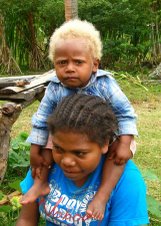
If there is one thing to be learned from European history in the Pacific is that after the merchants come the missionaries are sure to follow and indeed the first church in present day Vanuatu was erected in Anietjum in May of 1848 when a Scottish Presbyterian minister, John Geddie, built a large stone church that would seat hundreds of people in Anelghowhat village. Minister Geddie, in his fundamentalist Presbyterian mindset, outlawed everything from kava and dancing to participation in customary ceremonies. And although the minister converted nearly 3,000 of the original 12,000 inhabitants of the island, the seats of the large church would remain less than full due to the tragic epidemics that would leave the island's population as low as 250 by 1905. The first wave of epidemics struck prior to 1860 and nearly 3,500 lives were lost to influenza, diphtheria and whooping cough. The following year claimed half the remaining population due to dysentery and measles, the dead so numerous that bodies had no grave but the turquoise blue waters. The church itself was destroyed, albeit for some masonry relics, by a tsunami in 1875 and as I looked at this shell of a relic among the contemporary village it seemed a metaphor for a larger emptiness on the island, a tragic reduction in population and culture. Currently the population in Anietjum remains under 1000. The Reef Check workshop was held on in the largest village on the island, Anelgowhat which has nearly 600 villagers in several small stations facing Mystery Island. Today you can see results of strong family lines and a bottle necked genetic population, traits such as blond hair are much more common on this small island and I was amazed to see how many blond children ran about the village chasing each other in laughter.

Anietjum, in particular Anelgowhat village, was a ideal village to host a Reef Check workshop due to their high dependence on marine resources, impacts of large scale tourism (such as selling hundreds of lobsters and shells when the boats come in) and the rather large amount of fisheries related projects such as mariculture and restocking efforts by various agencies in Vanuatu. The island itself is surrounded by at least two large reef systems and is rich in marine resources while the communities are struggling to implement customary closures and implement management plans. There is a strong turtle monitoring program in Anietjum with a local man named Alan, capturing, measuring and tagging nearly 70 turtles a year and providing this data to a regional data base. The workshop in Anietjum focused on understanding the ecological effects of the changing economic and environmental conditions as well as re-enforcing local management techniques. Reef Check in many aspects can strengthen local tenure systems, through a system of cooperative management, which utilizing both traditional methods (taboos) and scientific methods of monitoring (Reef Check).


Two nights Katie and I were able to corral some participants away from the kava to go night diving for turtles. The first night was surreal and psychologically a bit challenging for me. The night waters were full of bio luminescent organisms, plankton that glow, and our boat chopped through what looked likes starts against a deep black night sea. As we are traveling in our 16 foot aluminum boat we are talking about the adventures of the past and fishing tales when our star turtle tagger relates a recent story of a night-time pursuit of a turtle which abruptly ended when he realized that a tiger shark, bigger than his boat, was also doing a bit of night time turtle hunting in the area. He leaves the last sentence hanging in the air as I am already perched, fins and mask on, ready to take that backwards flop into the water. I have no underwater flashlight and was resigned to following Alan in the water much like a cygnet follows the mother swan, probably a bit less graceful however. Alan would occasionally just turn the light off, leaving me in absolutely dark water save the ocean stars, those beautiful glowing plankton, which seemed so other-worldly. It only took about 5 minutes to catch the turtle which was sleeping in a shelf on the reef.

When the turtles are captured there is a form to be filled out which includes the species, length of the shell, width of the shell, and width of the head. Two metal tags are attached, each with different numbers, to the fleshy part of the front flippers, much like turtle ear rings. These tags are important and if recaptured will allow us to have some insight into the growth rates and migratory movements of the turtles. The shell of this green turtle was brilliant and one of the men said to us that the local language name for the green turtle in Anietjum translates to the "sunrise turtle" due to the sunburst pattern on the shell. Katie snapped a photograph.

The second time we went night diving, Alan our turtle guru was gone to a conference, ironically, about turtles, so we went with some "yangfala" (young men). They were a bit more enthusiastic although not as skilled and almost everyone jumped in this time (although we still shared flashlights with our Ni-Vanuatu guides). We took a bit longer but caught two turtles, one of which was already tagged. We took our cargo to shore on Mystery Island's white sand beaches and went through the motions of measuring, documenting and tagging before we released them to the sea. It was an amazing experience for me. This ancient lineage of animals which has in holds such a powerful imagery in my mind now, as both an icon of international conservation and the amazing differences on how various cultures dictate what is wild and free and what is fair game and consumable.


Prior to our visit, the local turtle monitoring group (Vanua Tai Group) coordinator gave me a map to show to the people of Anietjum and Tanna. The regional organization SHREP had put a GPS location tag on a large male green turtle in Bora Bora less than a year ago and the turtle had traveled through the Cook Islands, Niue, Tonga, Fiji and was headed for New Caledonia when it made a U-turn straight for Anietjum Island. It was in the area during the workshop and it was an interesting dialogue to have with the islanders, whom often consume the protected animals. Who did that turtle belong to? Debates on the harvesting of highly migratory species continues to be an imposing topic among the Pacific Island countries, which requires agreements, international consultation groups, cross cultural dialogue and treaties. At the grass roots level, no treaty will save a wondering turtle that crosses the path of a rural islander. The most important thing at this level is education, awareness and wise-use. Programs such as the Vanua Tai Turtle Monitoring Program and Reef Check provide resource users with information about life cycles and environmental consequences to human actions, allowing people to make informed decisions. The Ni-Vanuatu of Anietjum, like many islanders in the south Pacific, are the stewards and users of the resources of the land and sea and ultimately hold the reins of sustainability and subsistence, consumption and conservation in their hands.

-Jessica

Friday, May 25, 2007

Customary Marine Tenure in Vanuatu


Throughout Vanuatu the terrestrial and marine resources are managed through a Customary Tenure system. This has wide ranging implications when working in resource management and conservation for both the Ni-Vanuatu involved and the biodiversity here in Vanuatu. Throughout my service here, as a Peace Corps volunteer serving as a “Coastal Resources Management Advisor,” first in a rural village of Malekula and now as the National Coordinator for Reef Check Vanuatu, I have had to work within and have an understanding of this management system. So I guess this blog is meant to give a brief explanation of the Customary Marine Tenure system here in Vanuatu. So what is Customary Marine Tenure (CMT) anyway?
In Vanuatu, through customary chiefs, families or tribes (nasaras), Ni-Vanuatu retain exclusive rights to harvest marine resources in near shore waters.
The constitution of Vanuatu upholds these rights in Chapter 12 Article 73 which states: “All land in the Republic belongs to the indigenous custom owners and their descendants.” “Land” in Vanuatu is defined under the Land Reform Act as including “land extending to the seaside of any offshore reef” and CMT is a system where the management of the near shore reefs is the responsibility of the customary reef owners. This system varies greatly from the management system in the United States at which anything from the high tide mark is under the management of the government and harvesting, activities and regulations are products of statutory law. In Vanuatu, “customary” tenure refers to the present practices of management which are rooted in custom or historical practices but not necessarily identical to past practices... Think flexibility. This means that some of the practices are historically rooted, such as the placing of a “taboo leaf,” although the motivation and restrictions can change according to contemporary needs and knowledge. So the placement of a “taboo” on a reef area (traditional practice) could now restrict only the use of a modern technology, such as gill nets (which are not customarily used) and this is still considered “customary marine tenure.”
CMT varies from village to village within an island and between islands and has strong ties to different language groups, customs, rules and norms and different land tenure systems.
There is a great deal of renewed interest in CMT in Vanuatu today in many areas. I say renewed because many of the customary practices have not been exercised in many years due to the overall degrading of customary ceremonies, rights and rituals in Vanuatu. Contemporarily Ni-Vanuatu are interested in exercising their rights to manage their dwindling resources and this is largely due to marine resources in Vanuatu facing increased fishing and harvesting pressure due to:
* Increased population (and ecological footprint per capita)
*Introduction of more “efficient” fishing technology
*Dependence on cash economy and commercialization of marine resources
In addition to human impacts on near shore marine areas Vanuatu is also very susceptible to natural disturbances such as earthquakes and cyclones, which can have a great impact on coral reefs and availability of resources in Vanuatu.

There are many different kinds of CMT techniques being practices. SOME are for conservation reasons and others are not. The most commonly used technique is the traditional marine taboo. Customarily the taboo was used for wide ranging purposes.
Conservation Taboos
* Areas in which marine resources are heavily depended on for subsistence and contemporarily, for economic purposes conservation taboos may be used.
*Contemporary surge in this type of taboo today in Vanuatu.
Death Taboos:
* Some areas would have used taboos in the event of the death of a chief or any family member’s death.
* Time periods and extent would vary by area and culture
Circumcision taboos:
* A taboo may be put in place when an age-class of males goes through circumcisions ceremonies.
Taboos related to Yam Seasons
*Taboos may be imposed at the planting of, harvesting of or growing duration of yams.
* Also may be behavioral taboos or consumption taboos related to yams and marine resources (For example in Unua, Malekula if you consumed turtle you can’t eat, plant or touch a yam for five days because if you do your yams will grow like the flipper of the turtle)
Taboos related to Feasts or Festivals
* Customary taboos were often used to enhance the size and amount of fishing stocks in preparation for a large feast, marriage or festival.
*Most “conservation taboos” are related to the idea of increasing stocks for consumption

Initiating taboos generally are locally and culturally determined and may be either formally announced without any formality or proclaimed with a special, site specific, ceremony which usually will involve the killing of pig or large feast and placing of the “namele” or locally relevant taboo leaves. Taboos that incorporate customary practices are generally viewed as more powerful and respected by community members. Contemporarily many traditional ceremonies have now incorporated written agreements and management plans which is testament to the flexibility of the CMT system. The taboo is a flexible management tool that is the embodiment of the customary tenure system giving a chief or landowners the right to restrict harvest and activities in a reef or near shore area. Taboos may vary in several ways:
* Taboos may be seasonal or annual for species specific breeding needs.
* Taboos may be “full closure,” multi-species or species specific
* Taboos may vary in temporal length.
* Taboos may restrict certain fishing technologies.
In Vanuatu within the CMT system gender is an important component with men, women, boys and girls each having a role to play in CMT and their activities, targeted species and harvest techniques will vary from island to island and village to village. In general men often participate in off-shore fishing, deep sea fishing and diving for invertebrates. Boys often fish, dive within deeper reef areas, go spear fishing, and night diving with underwater spear guns. While women, girls and small children often fish in near shore areas, participate in reef gleaning, dig for bivalves and collect invertebrates such as octopus at low tide.

Because much of Vanuatu is involved within a subsistence economy, reef closures are significant short term sacrifices that strive to fill a long-term subsistence need in the village. During reef closures villages may need to mitigate the loss of marine protein by:
*Increasing dependence and utilization of land animals for protein
*Fish outside the taboo area (deep water fishing)
*Cut back on consumption
* Purchase canned meat or fish
* Buy fresh fish from nearby markets
* Negotiate for the rights to fish in neighboring fishing grounds.


There are many issues in the contemporary marine tenure system in Vanuatu that may affect the effectiveness and ability to exercise CMT. After the return of land in the 1980’s many coastal areas, especially in urban areas, fell under dispute and remain untenured. In addition the increased economic valuable of marine resources, disagreements about customary boundaries, population pressure and loss of respect for CMT have resulted in disputes over tenure and management in some areas. Vanuatu’s growing dependency on a cash economy also affects the tenure system and increases the likelihood of unsustainable marine harvesting. Much of the export economy related to marine resources and the tourist industry puts additional strain on near shore areas through curio-sales and infrastructure developments. And although legally the Land Lease Act stipulates that customary owners cannot lease their reef areas, access and tenure can only be done through a contract between the lessee and leaser. It is not uncommon that a Ni-Vanuatu finds himself frustrated because he failed to dictate the right to pass over leased ground to reach the reef area.
The flexibility of the CMT system is a strength allowing the adaptation of new management techniques to match the changing economical and ecological situation. In many aspects this is where I and other environmental extentionist have entered the mix here in Vanuatu. Ni-Vanuatu villagers are very hungry for advice when it comes to their coastal resources. However, villages do not want to be told how to manage their reefs or fisheries and it is their customary and legal right not to be micro-managed by outsiders. In order to work within the CMT system here in Vanuatu, you must respect it and value it within your project. Ni-Vanuatu customary managers do want to receive education relating to contemporary practices, technologies and management techniques... They want to know what management techniques are available, where, when and how long to apply these techniques. In the end, it is completely up to them to take control of their resources and most managers are seeking out information and new techniques to make well informed decisions. Many times this may involve looking back to past practices and knowledge and giving equal value and respect to those techniques as well as newer “scientific” explanations. I guess that is the extent of my spill on customary marine tenure and I would be confident in saying that during my service here in Vanuatu the local people taught me more about management and the need for conservation of both biological and cultural resources than I was able to teach them.

-Jessica

Translation of “Kastom storian blong Flaeing Fokis”

Custom story of the Flying Fox

Why doesn’t the flying fox eat during the day? One day all the animals of the air were fighting with all the animals of the ground. The flying fox didn’t join the animals of the air to fight; instead he just watched the unfolding fight. The fight continued and when finally finished the animals of the air where angry with the flying fox. They threw him out and told him, “You are no longer family now.” So now the flying fox is shamed, afraid and can only eat under the cover of night!


-Story told in Unua, southeast Malekula Island, Republic of Vanuatu

Saturday, April 7, 2007

Be wanem samting ia "Bislama?"

What is "Bislama?"
Communicating in Vanuatu could be challenging for even the most resolute linguist. As I have mentioned earlier there are an estimated 130 local languages found on the 60 plus inhabited islands here in the South Pacific. This is among the highest language diversity per capita in the world. There are three official languages that are recognized by the national government and documents, policies and news may be reported in Bislama, English or French. Bislama, however, is the dominating language that binds the country together; the literate to the illiterate, rural to the urban and the northern most islands to the southern most islands. Being unable to communicate in Bislama will render you unable to effectively communicate with Ni-Vanuatu peoples, especially in a village setting in which about 80% of the country lives. But what is Bislama? Where did the language come from?
"Bislama" is the Ni-Vanuatu version of a group of Melanesian Pidgin Languages which also includes "Tok Pidgin" in Papau New Guinea and "Pidgin" in the Solomon Islands. These pidgin languages arose as Europeans discovered valuable natural resources in these island countries starting in about the mid-1880's, especially sought after was sandalwood and that good old colonial gold..."labor." The Ni-Vanuatu peoples were moved around from island to island and had to work together with a group of islanders that didn't speak a word of their local tongue and a group of pale faced Europeans that certainly seemed to be running the show. This linguistic negotiation rendered "Bislama" which is a pidgin of English which a lot of Melanesian context and grammar. "The name of the language derives from the nineteenth-century word Beach-la-Mar, which itself derives from the French biche de mer 'sea cucumber'. (Crowly, Terry)." Beche-la-mer or Sea Cucumbers were also collected and dried by the French during this initial flurry of economic exploitation. (Photograph is Ben teaching a slope stability session in Malekula, the board reads " Tri= Helti Riva= Helti Rif" or Trees = Healthy Rivers= Healthy Reefs)
I remember thinking that Bislama would be an extremely easy language to pick up and learn, like some children playing around with Pig Latin... well that isn't really the case. The accent can be bewildering, the tenses are utterly confusing and many words have several meanings. Fortunately the whole language is written "FONETIKELI" (or phonetically - Ben loves to point out how the word phonetically is not phonectical- ironic huh?) This means that there is no letter "C, Q, X or Z." Most common English verbs will be understood by attaching a "um, im or em." However there is no verb "to be." The word "stap" means "I am," "to stay, to live (in one place)" or a prefix that is attached to a verb to express the present tense. See where some confusion can come in. So technically you could have a sentence like this: " Mi stap stap." ( I am staying here.)
Even more interesting to learn is all of the Bislama names for trees, plants, birds, fish and all sorts of other environmental wonders. These words don't take the English cognate in most cases. Many of the Bislama language names for trees, birds and common invetebrates are taken from a local language in Ambae Island and many of them have the prefix "na." So for example some animals and plants are: namarae (eels), namaloa (incubator bird), natalae (giant clams), nawita (octopus), nabanga (banyan tree) or nambilak (Kingfisher bird). (Photograph: Jessica teaching a group of 16 men Reef Check on Gaua island, everything is in Bislama written materials, lectures and powerpoints).
After about 3 months of living here you can understand most everything being said (although slang is rampant here and everything can be metaphorical) and you are able to speak at a fluency that allows you to eat, sleep and go to the restroom without little embarrassment. After about 6 months in a rural area you are catching on to some slang and are able to without a doubt know when someone is speaking about you to someone else. You also may need to learn local language for basic expressions like "good morning." Unfortunately for all of you that have kept your language free of swears and vulgarities many of our "four letter words" are perfectly acceptable to use in Bislams. (ie.- "as" means your butt, "sitsit" or "sit" pronounced like the English cognate means "to defecate, or the noun poop") Swearing does certainly exist in Bislama, many of which may be direct cognates or creative and descriptive phrases that I dare not write on this blog.
There are a lot of fun slang terms or phrases that literally translated would be confusing, such as "Mi stap tekem truk blong Adam." This literally translated into " I am taking Adam's truck." but means " am going to walk (Adam and Eve and his truck....two legs.. well you get it right)." Another one involving trucks (and subsequently the fact that most water sources here are ice cold) is "truk blong wota i pas finis." This literally translates to "the water truck has already passed," but means "it is too stinking late or cold and I am not going to bath tonight." Well you guys get the idea.

So for some of you that are brave and like a challenge, this is a small story written in Bislama that you can try and translate. I will give the English translation in a future blog to come. This is a custom story from Malekula Island, although I have heard variations of this story from other islands as well:

Kastom Storian blong Flaeing Fokis


From wanem flaeing fokis i no kaekae long dei? Wan dei olgeta animol long ae oli stap rao wetem ol animol long graon. Flaeing fokis i no join wetem olgeta animol long ae blong faet, hemi stap lukluk nomo. Rao ia i stap gogo, i finis mo afta ol animol blong ae oli kros wetem flaeing fokis mo oli sakem aot hem mo talem "yu no famili wetem mifala naoia!" Naoia flaeing fokis hemi shem mo fret mo hemi mas kaekae long kava blong naet nomo!

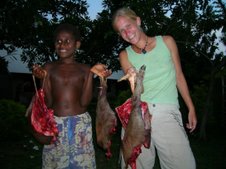
Look for the translation to this story in another post to come! The picture of the man holding "a bat" is actually a "flying fox" (hint hint) which is what the story above is about. Incidently the flying fox in Timothy's hand was our supper one night... taste great with coconut milk!

-Jessica

Saturday, March 31, 2007

The Ni-Vanua -WHO?

Who are the Ni-Vanuatu?

Thought it might be interesting to give a small bit of history on this group of people that share our little blue planet called the NI-VANUATU. Ni-Vanuatu are Melanesian peoples who arrived in Vanuatu approximately 3,000 -3,500 years ago as people from the Lapita culture (a culture characterized by particular textile and pottery patterns and manufacturing processes) moved from southeast Asia. "The term Lapita refers to an ancient Pacific culture that archaeologists believe to be the common ancestor of the contemporary cultures of Polynesia, Micronesia, and some areas of Melanesia. The culture takes its name from the site of Lapita in New Caledonia, one of the first places in which its distinctive pottery was discovered. While archaeologists debate the precise region where Lapita culture itself developed, the ancestors of the Lapita people came originally from Southeast Asia. Beginning around 1500 B.C., Lapita peoples began to spread eastward through the islands of Melanesia and into the remote archipelagos of the central and eastern Pacific, reaching Tonga and Samoa by roughly 1000 B.C. The Lapita were a seafaring people who settled primarily on the coast rather than inland and their skilled navigators traversed the ocean with ease. (Wagelie, Jennifer)"
The island of Vanuatu, which is a volcanic archipelago of nearly 80 islands, has a rich cultural and linguistic heritage.


On the island of Malekula alone, where Ben and I were stationed for two years, there are about 30 distinct languages still spoken. Many languages, cultural beliefs, customs and traditional systems of land tenure have been lost... many still dominate peoples lives. Vanuatu began its cultural interactions with Europeans as early as 1606 when a Portuguese ship "discovered" the islands and it was subsequently "rediscovered" by French navigator Louis-Antoine de Bougainville in 1768. Explored once again by an English mariner the famed Captain James Cook in 1774 and given the name "New Hebrides." An onslaught of missionaries, sandalwood merchants, and British and French cotton farmers arrived in the mid-19th century and the condominium government, a joint venture by the French and the British, was established in 1906. Can you imagine being under both French and British rule? This meant two school systems, two governmental bodies, two administrations and twice the bureaucracy which is a legacy that has left Vanuatu with three national languages: English, French and Bislama (from the "Black birding"- a history of stealing natives to work on Australian cotton and sugar plantations in Queensland). Finally in July of 1980 the "New Hebrides" achieved Independence and changed their name to "Vanuatu" (Hints the name Ni-Vanuatu for a native of Vanuatu).
Who are the Ni-Vanuatu now? Well I have been here for three years and stereotyping the Ni-Vanuatu would be like trying to describe what is an "American." The islands are diverse culturally, linguistically and in many cases historically. But if forced to talk about the peoples with whom I have lived for the last 3 years I would be comfortable to say this:

Ni-Vanuatu are largely ritualistically Christian yet also maintain strong beliefs in custom, black magic and traditional healing.

Ni-Vanuatu are inseparable from their land, family and natural resources.

Ni-Vanuatu are can be incredibly kind and yet, at times, as temperamental as the the ocean that surrounds them.

Ni-Vanuatu love to smile and laugh. They are boisterous and jovial.

Ni-Vanuatu are islanders, they live by "island time" and no amount of coxing will change their internal clocks. They value time with their family and friends, work will always come second to their family obligations.

Ni-Vanuatu see themselves first as members of their tribe or nasara, second as people from their home island, third their province (group of geographically link islands) and lastly their nation.

Ni-Vanuatu value community and togetherness more than the individual.


Contemporary the Ni-Vanuatu operate under a free-market economy. The main industry in Vanuatu is copra (dried coconut meat), cattle raising, agriculture, forestry and fishing. Tourism is definitely beginning to make a surge on the economic stage, which in my opinion is very unstable in regards to cultural ramifications and economic stability. Vanuatu is a country that is young and still defining what it means to be the Nation of Vanuatu. Trying to find a balance between customary culture and contemporary-global demands.

-Jessica

Photograph and quotation on Lapita peoples: Wagelie, Jennifer (October 2003) -see link for The Metropolitan Museum of Art: Lapita Pottery
Tuesday, March 27, 2007

The Coolidge: US and Vanuatu's Histories Crash

I must say that I really believed that I was going to be an “environmental diver” all the way and had very little interest in diving man-made “disasters” such as ship wrecks. However, diving the USS President Coolidge made a real impression on me and excited me with its massive-imposing figure as well as its history. SCUBA diving by its very nature may be un-nerving; whether staring out into the deep endless blue (and remembering your rather low-rung on the food chain) or night diving when you imagine about everything is only a couple meters away looking at you with hungry eyes (and you can’t see a thing). I have had the pleasure now of diving for work related tasks, although I would hardly call it work, and I explore things at a slow and meticulous pace looking for the ocean’s many minute wonders. Diving a ship wreck is a very different experience… overwhelming at times to see such a massive piece of history, steel and sweat quietly (and eerily) sleeping underwater. You do not get a visual, minus the large tethered anchor rope from shore, until you reach 70 feet in depth and then there is a massive bow of this 654 foot luxury liner turned war ship during WWII.
The ship, which was requisitioned in 1941, was carrying 5,000 troops destined to reinforce and relieve Marines in Guadalcanal when on October 26, 1942 it stuck two mines explosives in the Segond Channel, Santo Island. These explosives had been laid by the US Navy to discourage enemy attack and they were very effective, sinking the massive steamer in only 85 minutes. Only two people were killed in the accident but valuable equipment, weapons and troops were either stranded or sleeping 70-240 feet under water (where the Coolidge lies today).
The water at 70 feet is already murky with little visibility. The ship is amazing; its alive with the numerous creatures, corals, sponges, sea fans inhabiting its slowly decaying structure and yet dead, solemn and imposingly dreary like its war-torn history. Large fish lurk at this depth avoiding the village spear fisherman but less hidden from hand held long lines. Still the groupers and angelfish reach sizes below 70 meters that would be inconceivable closer to the hungry Ni-Vanuatu at shore. Because the ship sleeps on her side you must enter through access panels that were cut from the ship in the 1960’s when they recovered the oil and gas in her belly. Often the bottom is not visible even with use of a flashlight from the top panels. It is dark and on occasion you frighten a fish from a dark and cold corner.
I only completed two dives the last time I went. The first one, at a depth of 130 feet, was a visit to “The Lady.” The lady was a piece of art that once hung in the first class smoking room during the luxury days before the war. During the war it was actually boarded over and found later when the rotting boards were removed under water. This dive is interesting mostly because you get yourself deep into the belly of the ship. On the way in you see large debris all laying on the port side of the ship; airplane drop tanks, jeeps with rusted axles and steering wheels, a barbers chair and large stainless steel cooking pots which were equipped to cook for the large navy crew. The second dive, shallower starting at about 90 feet, was to the medical office and cargo holds #1 and #2. These were really interesting dives, gas masks, tight squeezes, medicine bottles (with medicine still inside) and bullets clutter the hallways leading to medical supplies room. The cargo holds contain more large items, the jeeps, spare tires and the like. It was an amazing couple of dives on a shared piece of history linking the Ni-Vanuatu and American people together, the war and exposure to other cultures changing both countries so profoundly.
-Jessica