I have spent a good deal of time in the rich marine waters of Vanuatu. For a small volcanic island archipelago, the marine environment is one of the richest in terms of biodiversity and shear abundance of wild organisms as much of the terrestrial environment, particularly many of the vertebrates and plants, were transported along with their human counterparts all those years ago on voyaging canoes. As far as mammals go in Vanuatu, the flying fox with about 3-4 species and a few species of bat are just about as naturally occurring as it gets, the remaining mammals are cows, pigs, goats, dogs, cats and of course the omnipresent rats and mice (in differing varieties according to their human navigators- so they are a blend of European and Asiatic descent). There is however a high level of endomism (species occurring and evolving only in Vanuatu) among plants, reptile and avian species. Much more difficult to detect would be endomism in the marine environment, although I have no doubt Vanuatu holds unique treasures in that area as well. So I thought I would do a quick blog to introduce all of my land-loving friends and family to the tropical marine environment. As I generally taught this to incoming new volunteers in Vanuatu... I shall cheat and use many of the same lessons that I had in the past. This also gives me a chance to put a great amount of my underwater photos on-line of which I am generally proud (So prepare yourselves for a lot of photos and little substance).
First and foremost.... the base of the one of the most biologically rich ecosystems in the world. .. what the heck is coral anyway? Well coral is a symbiotic relationship between a minute (in most cases) animal called a coral polyp and an algae called zooanthellae. This symbiotic algae, that lives within the polyp’s tissue, provides the vast majority of the nourishment required by the polyp and subsequently also provides the coloration. These polyps live together in a colony or what we recognize as a coral. There are hundreds (possibly thousands) of species of coral, most of which are difficult to identify in the field and require microscopic analysis to properly identify at the species level. There are two loose and broad categories in which you can classify corals: hard or soft. In the case of hard corals they secrete calcium carbonate and actually live on top of this limestone secretion. Hard corals are important because they build the overall structure of coral reefs through the process of secreting calcium carbonate. This structure may be colonized by future coral polyps or by other coral reef organisms. Soft corals excrete a common skin rather than a hard skeleton and can extensively grow on all reef system, coming the most abundant in 10-30 meters of depth. They are important food sources on reefs and potential source of wonder drugs.
 .. what the heck is coral anyway? Well coral is a symbiotic relationship between a minute (in most cases) animal called a coral polyp and an algae called zooanthellae. This symbiotic algae, that lives within the polyp’s tissue, provides the vast majority of the nourishment required by the polyp and subsequently also provides the coloration. These polyps live together in a colony or what we recognize as a coral. There are hundreds (possibly thousands) of species of coral, most of which are difficult to identify in the field and require microscopic analysis to properly identify at the species level. There are two loose and broad categories in which you can classify corals: hard or soft. In the case of hard corals they secrete calcium carbonate and actually live on top of this limestone secretion. Hard corals are important because they build the overall structure of coral reefs through the process of secreting calcium carbonate. This structure may be colonized by future coral polyps or by other coral reef organisms. Soft corals excrete a common skin rather than a hard skeleton and can extensively grow on all reef system, coming the most abundant in 10-30 meters of depth. They are important food sources on reefs and potential source of wonder drugs.
  Due to the fact that corals are not only a living organism but also are a result of an unusual relationship between an animal, polyp, and an algae called zooanthellae there are many things that can damage corals, killing the coral polyps or destroying the entire colony. Corals face both human and natural impacts and damaging events. Some of the natural events and predation that corals face are:
- Cyclones or strong wave or tide surges
- Predation by fish or organisms that consume polyps or zooanthellae (such as Parrot fishes which eat hard corals and "poo" the nice white sand beaches everyone lays on)
- Seismic activities such as earthquakes or underwater volcanoes
- Freshwater run-off
- Algal blooms
- Introduced or invasive species
- Coral diseases
 It is important to remember that like all ecosystem coral reefs are dynamic systems with periodic disturbance. Human impacts, however tend to be chronic and not allow a recovery period. Human disturbances often may exacerbate natural ecosystem disturbances and may slow or halt coral reef recovery. Such human impacts include (but are not limited to) some of the following... remember to that I tailored this presentation to Vanuatu:
- Over harvesting of fish or invertebrates
 which clean or glean the reef: this includes the Aquarium Fish Trade (also worth mentioning in point two).
 - Predatory release is another issue when a given animal is over-harvested and this allows its prey to "release" or become very numerous... an possible example of this is the Crown-of-Thorns Starfish which eats coral reefs at an astonishing rate which is in turn eaten by the Triton Trumpet Shell (sold at markets for the curio trade).
- Using fish poisons (cyanide or customary) which kills coral polyps
- Reef Gleaning- walking on the reef to collect shells or invertebrates
- Inappropriate or damaging fishing practices such as dynamite or nets that drag the bottom
- Sedimentation or run-off from erosion or agricultural land
- Pollution (solid waste or industrial run-off)
- Global warming- which is being very closely monitored here in Vanuatu and causes the corals to stress, the polyps expel their zooanthellae and become "bleached." A coral that has bleached is essentially starving and has about 2 weeks to regain the photosynthetic zooanthellae.

 Of course I guess some could say, "Who cares about coral reefs?" The answers are many and you can take your pick between the down right conservation minded to the straight laced economically motivated. Here are a few that I often teach during my Reef Check trainings:
•Home to 25% of all marine fish and is required during the breeding times of numerous others.
•Support tourist economies, especially with over 20 million scuba divers in the waters around the world.
•A source of drugs for medical use (did you know that coral calcium can be used in bone graphing and to replace eye balls!)
•Food source for 300 million people worldwide and most of the coastal villages of Vanuatu.
•Coastal protection from wave erosion, hurricanes and tidal waves.
•Important to local and international cash economies of many nations, including Vanuatu.
In Vanuatu coral reefs and the inshore coastal areas are important in so many ways, with many communities in Vanuatu relying heavily on inshore or coastal fisheries which are accessible to men, women, boys and girls on almost a daily basis. In Vanuatu, coral reefs form the basis of the subsistence, local market and export (trochus) opportunities for many rural Ni-Vanuatu.
Culturally customary marine tenure plays a vital role in the management of coral reefs and also  the harvesting and processing techniques with men, women and youth each have role to play in harvesting resources from coral reefs. Having lived in Vanuatu for three years, few things surprise me anymore in regards to what is considered edible and not edible from the sea... anyone having spent much time in Asia will not find this very shocking. In Vanuatu people of course eat fish, numerous invertebrates (such as shells, lobsters and crabs) but also things like sea urchins, sea stars and the palolo worm or "nawel" as we call in Vanuatu. The "nawel" is a rather small, high "crunch" to meat ratio worm, that spawns and becomes plentiful only once or twice a year at the new moon in October. I shall struggle to remain completely culturally sensitive and not comment on the taste.
 the harvesting and processing techniques with men, women and youth each have role to play in harvesting resources from coral reefs. Having lived in Vanuatu for three years, few things surprise me anymore in regards to what is considered edible and not edible from the sea... anyone having spent much time in Asia will not find this very shocking. In Vanuatu people of course eat fish, numerous invertebrates (such as shells, lobsters and crabs) but also things like sea urchins, sea stars and the palolo worm or "nawel" as we call in Vanuatu. The "nawel" is a rather small, high "crunch" to meat ratio worm, that spawns and becomes plentiful only once or twice a year at the new moon in October. I shall struggle to remain completely culturally sensitive and not comment on the taste.
 However these diverse ecosystems, coral reefs which rival rainforest's diversity, is not just about fish and coral. There is a vast array of different life forms, functions and proliferation in the marine waters around the world. Here are a couple major categories:
 We start with Cnidarians (the stingers): Corals are Cnidarians. Coral growth forms may vary according to species, wave action, availability of light or disturbance regime. Common growth forms include; boulder, table, digitate, encrusting, foliose or mushroom. This remarkably diverse group includes jellyfish, hard and soft corals, gorgonian fans and sea whips, hydroids and anemones. Many contain stinging cells called nematocysts and some are deadly!
 Marine Plants are the basis of the marine and terrestrial food web, these primary producers range from microscopic to higher plants such as mangroves. There are two basic types; 1.marine algae, and 2. sea grasses and mangroves.
Sponges have the least complex body structure of all multi-celled creatures and are the reefs vacuum cleaners, filtering out bacteria and organic debris. While natural in a reef system, an overabundance generally indicates sewage or pollution, ie.... stinky, gross water!
Marine worms are diverse and there are thousands of species found in amazing array of habitats and four major groups; flatworms, polychaete worms, Ribbon worms and Acorn worms. Two popular varieties for divers are flatworms and Christmas tree worms. Christmas tree worms are found on boulder corals, and will suddenly vanish if you come too close. Flatworms are easily confused with Nudibranchs but pretty much just as cool. Christmas tree worms actually bore into the coral calcium and I believe using a bio-chemical process and they are very colorful.
 Nudibranchs (literally meaning "nude lung") and Sea Slugs are easily confused with flatworms, however these tiny colorful creatures are actually related to Mollusks (snails), the most colorful and attractive being the Nudibranch group. The majority feed on algae, sponges and some cnidarians. One Ni-Vanuatu Scuba-diving Reef Checker I trained in Santo became quite obsessed with Nudibranchs once she noticed their existence on the reef and gave me a bit of exercise because she wanted me to photograph and look at everyone she found!
Mollusks and Bivalves comprise one of the largest divisions in the entire animal kingdom with over 100,000 species represented worldwide. This group is extremely important in terms of subsistence as well as economically valuable as it includes bivalve shells such as oysters, shells sold for curio trade (such as the triton trumpet shell), trochus (which are used to make buttons) and giant clams (both consumed and sold to aquarium trade). Many of the animals are endangered and some are very dangerous, containing some of the most powerful neurotoxin in the world.
 Cephalopods are a major subdivision of the mollusk family and comprise of octopus, cuttlefish, squids and the nautilus. Many live in the open ocean or deep waters around the world but some species such as octopus are found in coral reef areas and are important predators as well as prey for hungry humans. Between 650-700 species of cephalopods have been documented worldwide but the group remains one of the most mysterious with new information being found every year.
 the entire animal kingdom with over 100,000 species represented worldwide. This group is extremely important in terms of subsistence as well as economically valuable as it includes bivalve shells such as oysters, shells sold for curio trade (such as the triton trumpet shell), trochus (which are used to make buttons) and giant clams (both consumed and sold to aquarium trade). Many of the animals are endangered and some are very dangerous, containing some of the most powerful neurotoxin in the world.
 Cephalopods are a major subdivision of the mollusk family and comprise of octopus, cuttlefish, squids and the nautilus. Many live in the open ocean or deep waters around the world but some species such as octopus are found in coral reef areas and are important predators as well as prey for hungry humans. Between 650-700 species of cephalopods have been documented worldwide but the group remains one of the most mysterious with new information being found every year.
Crustaceans are the most dominant group by far found on the reef systems with over 30,000 species worldwide, many of which are economically important and just down right tasty! The crabs, shrimps, lobsters and numerous microscopic organisms, which often are an important ecological food base, are related to land-loving Anthropoda which includes land insects, spiders and scorpions. In Vanuatu this group is very important for both local food (often served in coconut milk) and for local markets in Vila and Luganville. Traditionally there were some species reserved only for consumption by chiefs.
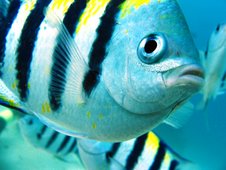
 The Marine Fishes are the iconic and often most conspicuous animals found on the reef and with nearly 7,000 species of the world wide 12,000 found on coral reefs or near shore areas, this is ecologically and economically an important group on Vanuatu's reefs. Approximately 638 species of fish associated with coral reefs alone have been documented in Vanuatu and many or these are consumed locally or sold to local and overseas markets. Coral reefs are also important nursery grounds for many transient or migrating species often sought after by fishing vessels such as tunas, trevally and sardines. In Vanuatu many coastal communities have specific names for each species in local language and sometimes may have different names for juveniles or male and female of one particular species!
Marine Reptiles includes sea snakes, with nearly 50 species worldwide, and turtles the ancient lineage which is nearly 150 million years old. The sea snake is differentiated from the eels by distinct scales and lack of gills. Sea snakes may be extremely poisonous although non-aggressive. All species of turtles are considered threatened or endangered internationally but yet are still killed for certain ceremonies and consumed for subsistence purposes in Vanuatu.
Marine mammals, such as dolphin or porpoises, dugong and their relative in the Atlantic the manatee, are found in warm tropical seas. The dolphin or porpoises are rarely spotted near shore while the dugong often feeds on near shore sea grass beds and is totally protected under Fisheries Laws of Vanuatu. Whales may also venture into Vanuatu's waters during the winter months of the temperate zones.
Marine birds are also important within the coral reef and near shore ecosystems as they are predators and natural reef gleaners. Many consume crabs, bivalves, micro-crustaceans, fish, baby turtles and eggs.
 Humans in almost all coastal areas worldwide serve as a mega-predator and may have large impacts structurally and ecologically on coral reef ecosystems! Humans are one of the few animals that have the capacity to change their ecological relationship in the coral reef systems as well and need to constantly adapt, monitor and manage themselves in regards to this delicate system in order to maintain healthy coral reefs for future generations. Check out the link on the right for Reef Check International for more information on coral reefs worldwide.
-Jessica