Saturday, April 7, 2007

Be wanem samting ia "Bislama?"

What is "Bislama?"
Communicating in Vanuatu could be challenging for even the most resolute linguist. As I have mentioned earlier there are an estimated 130 local languages found on the 60 plus inhabited islands here in the South Pacific. This is among the highest language diversity per capita in the world. There are three official languages that are recognized by the national government and documents, policies and news may be reported in Bislama, English or French. Bislama, however, is the dominating language that binds the country together; the literate to the illiterate, rural to the urban and the northern most islands to the southern most islands. Being unable to communicate in Bislama will render you unable to effectively communicate with Ni-Vanuatu peoples, especially in a village setting in which about 80% of the country lives. But what is Bislama? Where did the language come from?
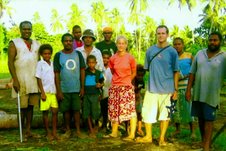
"Bislama" is the Ni-Vanuatu version of a group of Melanesian Pidgin Languages which also includes "Tok Pidgin" in Papau New Guinea and "Pidgin" in the Solomon Islands. These pidgin languages arose as Europeans discovered valuable natural resources in these island countries starting in about the mid-1880's, especially sought after was sandalwood and that good old colonial gold..."labor." The Ni-Vanuatu peoples were moved around from island to island and had to work together with a group of islanders that didn't speak a word of their local tongue and a group of pale faced Europeans that certainly seemed to be running the show. This linguistic negotiation rendered "Bislama" which is a pidgin of English which a lot of Melanesian context and grammar. "The name of the language derives from the nineteenth-century word Beach-la-Mar, which itself derives from the French biche de mer 'sea cucumber'. (Crowly, Terry)." Beche-la-mer or Sea Cucumbers were also collected and dried by the French during this initial flurry of economic exploitation. (Photograph is Ben teaching a slope stability session in Malekula, the board reads " Tri= Helti Riva= Helti Rif" or Trees = Healthy Rivers= Healthy Reefs)
I remember thinking that Bislama would be an extremely easy language to pick up and learn, like some children playing around with Pig Latin... well that isn't really the case. The accent can be bewildering, the tenses are utterly confusing and many words have several meanings. Fortunately the whole language is written "FONETIKELI" (or phonetically - Ben loves to point out how the word phonetically is not phonectical- ironic huh?) This means that there is no letter "C, Q, X or Z." Most common English verbs will be understood by attaching a "um, im or em." However there is no verb "to be." The word "stap" means "I am," "to stay, to live (in one place)" or a prefix that is attached to a verb to express the present tense. See where some confusion can come in. So technically you could have a sentence like this: " Mi stap stap." ( I am staying here.)
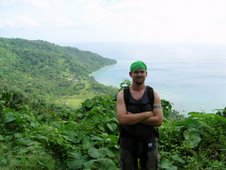
Even more interesting to learn is all of the Bislama names for trees, plants, birds, fish and all sorts of other environmental wonders. These words don't take the English cognate in most cases. Many of the Bislama language names for trees, birds and common invetebrates are taken from a local language in Ambae Island and many of them have the prefix "na." So for example some animals and plants are: namarae (eels), namaloa (incubator bird), natalae (giant clams), nawita (octopus), nabanga (banyan tree) or nambilak (Kingfisher bird). (Photograph: Jessica teaching a group of 16 men Reef Check on Gaua island, everything is in Bislama written materials, lectures and powerpoints).
After about 3 months of living here you can understand most everything being said (although slang is rampant here and everything can be metaphorical) and you are able to speak at a fluency that allows you to eat, sleep and go to the restroom without little embarrassment. After about 6 months in a rural area you are catching on to some slang and are able to without a doubt know when someone is speaking about you to someone else. You also may need to learn local language for basic expressions like "good morning." Unfortunately for all of you that have kept your language free of swears and vulgarities many of our "four letter words" are perfectly acceptable to use in Bislams. (ie.- "as" means your butt, "sitsit" or "sit" pronounced like the English cognate means "to defecate, or the noun poop") Swearing does certainly exist in Bislama, many of which may be direct cognates or creative and descriptive phrases that I dare not write on this blog.
There are a lot of fun slang terms or phrases that literally translated would be confusing, such as "Mi stap tekem truk blong Adam." This literally translated into " I am taking Adam's truck." but means " am going to walk (Adam and Eve and his truck....two legs.. well you get it right)." Another one involving trucks (and subsequently the fact that most water sources here are ice cold) is "truk blong wota i pas finis." This literally translates to "the water truck has already passed," but means "it is too stinking late or cold and I am not going to bath tonight." Well you guys get the idea.

So for some of you that are brave and like a challenge, this is a small story written in Bislama that you can try and translate. I will give the English translation in a future blog to come. This is a custom story from Malekula Island, although I have heard variations of this story from other islands as well:

Kastom Storian blong Flaeing Fokis


From wanem flaeing fokis i no kaekae long dei? Wan dei olgeta animol long ae oli stap rao wetem ol animol long graon. Flaeing fokis i no join wetem olgeta animol long ae blong faet, hemi stap lukluk nomo. Rao ia i stap gogo, i finis mo afta ol animol blong ae oli kros wetem flaeing fokis mo oli sakem aot hem mo talem "yu no famili wetem mifala naoia!" Naoia flaeing fokis hemi shem mo fret mo hemi mas kaekae long kava blong naet nomo!

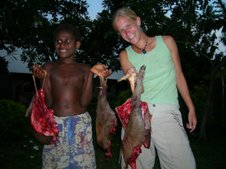
Look for the translation to this story in another post to come! The picture of the man holding "a bat" is actually a "flying fox" (hint hint) which is what the story above is about. Incidently the flying fox in Timothy's hand was our supper one night... taste great with coconut milk!

-Jessica

Saturday, March 31, 2007

The Ni-Vanua -WHO?

Who are the Ni-Vanuatu?

Thought it might be interesting to give a small bit of history on this group of people that share our little blue planet called the NI-VANUATU. Ni-Vanuatu are Melanesian peoples who arrived in Vanuatu approximately 3,000 -3,500 years ago as people from the Lapita culture (a culture characterized by particular textile and pottery patterns and manufacturing processes) moved from southeast Asia. "The term Lapita refers to an ancient Pacific culture that archaeologists believe to be the common ancestor of the contemporary cultures of Polynesia, Micronesia, and some areas of Melanesia. The culture takes its name from the site of Lapita in New Caledonia, one of the first places in which its distinctive pottery was discovered. While archaeologists debate the precise region where Lapita culture itself developed, the ancestors of the Lapita people came originally from Southeast Asia. Beginning around 1500 B.C., Lapita peoples began to spread eastward through the islands of Melanesia and into the remote archipelagos of the central and eastern Pacific, reaching Tonga and Samoa by roughly 1000 B.C. The Lapita were a seafaring people who settled primarily on the coast rather than inland and their skilled navigators traversed the ocean with ease. (Wagelie, Jennifer)"
The island of Vanuatu, which is a volcanic archipelago of nearly 80 islands, has a rich cultural and linguistic heritage.


On the island of Malekula alone, where Ben and I were stationed for two years, there are about 30 distinct languages still spoken. Many languages, cultural beliefs, customs and traditional systems of land tenure have been lost... many still dominate peoples lives. Vanuatu began its cultural interactions with Europeans as early as 1606 when a Portuguese ship "discovered" the islands and it was subsequently "rediscovered" by French navigator Louis-Antoine de Bougainville in 1768. Explored once again by an English mariner the famed Captain James Cook in 1774 and given the name "New Hebrides." An onslaught of missionaries, sandalwood merchants, and British and French cotton farmers arrived in the mid-19th century and the condominium government, a joint venture by the French and the British, was established in 1906. Can you imagine being under both French and British rule? This meant two school systems, two governmental bodies, two administrations and twice the bureaucracy which is a legacy that has left Vanuatu with three national languages: English, French and Bislama (from the "Black birding"- a history of stealing natives to work on Australian cotton and sugar plantations in Queensland). Finally in July of 1980 the "New Hebrides" achieved Independence and changed their name to "Vanuatu" (Hints the name Ni-Vanuatu for a native of Vanuatu).
Who are the Ni-Vanuatu now? Well I have been here for three years and stereotyping the Ni-Vanuatu would be like trying to describe what is an "American." The islands are diverse culturally, linguistically and in many cases historically. But if forced to talk about the peoples with whom I have lived for the last 3 years I would be comfortable to say this:

Ni-Vanuatu are largely ritualistically Christian yet also maintain strong beliefs in custom, black magic and traditional healing.

Ni-Vanuatu are inseparable from their land, family and natural resources.

Ni-Vanuatu are can be incredibly kind and yet, at times, as temperamental as the the ocean that surrounds them.

Ni-Vanuatu love to smile and laugh. They are boisterous and jovial.

Ni-Vanuatu are islanders, they live by "island time" and no amount of coxing will change their internal clocks. They value time with their family and friends, work will always come second to their family obligations.

Ni-Vanuatu see themselves first as members of their tribe or nasara, second as people from their home island, third their province (group of geographically link islands) and lastly their nation.

Ni-Vanuatu value community and togetherness more than the individual.


Contemporary the Ni-Vanuatu operate under a free-market economy. The main industry in Vanuatu is copra (dried coconut meat), cattle raising, agriculture, forestry and fishing. Tourism is definitely beginning to make a surge on the economic stage, which in my opinion is very unstable in regards to cultural ramifications and economic stability. Vanuatu is a country that is young and still defining what it means to be the Nation of Vanuatu. Trying to find a balance between customary culture and contemporary-global demands.

-Jessica

Photograph and quotation on Lapita peoples: Wagelie, Jennifer (October 2003) -see link for The Metropolitan Museum of Art: Lapita Pottery

Tuesday, March 27, 2007

The Coolidge: US and Vanuatu's Histories Crash

I must say that I really believed that I was going to be an “environmental diver” all the way and had very little interest in diving man-made “disasters” such as ship wrecks. However, diving the USS President Coolidge made a real impression on me and excited me with its massive-imposing figure as well as its history. SCUBA diving by its very nature may be un-nerving; whether staring out into the deep endless blue (and remembering your rather low-rung on the food chain) or night diving when you imagine about everything is only a couple meters away looking at you with hungry eyes (and you can’t see a thing). I have had the pleasure now of diving for work related tasks, although I would hardly call it work, and I explore things at a slow and meticulous pace looking for the ocean’s many minute wonders. Diving a ship wreck is a very different experience… overwhelming at times to see such a massive piece of history, steel and sweat quietly (and eerily) sleeping underwater. You do not get a visual, minus the large tethered anchor rope from shore, until you reach 70 feet in depth and then there is a massive bow of this 654 foot luxury liner turned war ship during WWII.
The ship, which was requisitioned in 1941, was carrying 5,000 troops destined to reinforce and relieve Marines in Guadalcanal when on October 26, 1942 it stuck two mines explosives in the Segond Channel, Santo Island. These explosives had been laid by the US Navy to discourage enemy attack and they were very effective, sinking the massive steamer in only 85 minutes. Only two people were killed in the accident but valuable equipment, weapons and troops were either stranded or sleeping 70-240 feet under water (where the Coolidge lies today).
The water at 70 feet is already murky with little visibility. The ship is amazing; its alive with the numerous creatures, corals, sponges, sea fans inhabiting its slowly decaying structure and yet dead, solemn and imposingly dreary like its war-torn history. Large fish lurk at this depth avoiding the village spear fisherman but less hidden from hand held long lines. Still the groupers and angelfish reach sizes below 70 meters that would be inconceivable closer to the hungry Ni-Vanuatu at shore. Because the ship sleeps on her side you must enter through access panels that were cut from the ship in the 1960’s when they recovered the oil and gas in her belly. Often the bottom is not visible even with use of a flashlight from the top panels. It is dark and on occasion you frighten a fish from a dark and cold corner.
I only completed two dives the last time I went. The first one, at a depth of 130 feet, was a visit to “The Lady.” The lady was a piece of art that once hung in the first class smoking room during the luxury days before the war. During the war it was actually boarded over and found later when the rotting boards were removed under water. This dive is interesting mostly because you get yourself deep into the belly of the ship. On the way in you see large debris all laying on the port side of the ship; airplane drop tanks, jeeps with rusted axles and steering wheels, a barbers chair and large stainless steel cooking pots which were equipped to cook for the large navy crew. The second dive, shallower starting at about 90 feet, was to the medical office and cargo holds #1 and #2. These were really interesting dives, gas masks, tight squeezes, medicine bottles (with medicine still inside) and bullets clutter the hallways leading to medical supplies room. The cargo holds contain more large items, the jeeps, spare tires and the like. It was an amazing couple of dives on a shared piece of history linking the Ni-Vanuatu and American people together, the war and exposure to other cultures changing both countries so profoundly.
-Jessica

Three years and many laplaps later...

Nearly three years has passed since Benjamin and I arrived in the Republic of Vanuatu to serve as Peace Corps volunteers. I remember the flight on April 17th, 2004 quite distinctly as a plane closed on the islands of Vanuatu and approached the capital city of Port Villa on Efate Island. The speculations, laughter and conversations between the 15 “new recruits,” destined to spend the next two years as volunteers, gave way to silence and 15 noses pressed against about 8 windows looking down into a matrix of coconuts, cattle and tin-roofed residential structures. I remember thinking how very, very, very small the largest town in Vanuatu was and how odd it looked against an otherwise rural-rugged tableau of Efate Island.
Efate island houses nearly a quarter of the country’s 200,000 plus populace and the majority of the Ni-Vanuatu people on this island live in or around the capital city of Port Villa. The vast majority of the island is still quite rural. In fact Vanuatu as a whole is quite rural with about 80% of the country living in rural villages scattered through this volcanic archipelago. Only a handful, and I mean about 4 or 5 towns have electricity. Efate, much like many of the larger islands such as Malekula, Santo and Tanna, is sparsely populated within the dense and rugged terrain interiors, with the majority of the population living near the coast and subsequently, the dirt or coral roads.
Our first taste of rural Vanuatu was to come during a ten-week training in a rural village called “Epau” in the northeastern side of Efate Island. There, adopted into a local family and living among approximately 300 villagers, we were to learn about the Ni-Vanuatu way of life. Not a small task for 10 weeks: learning the ins and outs of a new culture, gender roles, language, technical skills, language and practical knowledge like cooking over a fire or opening a coconut (without using your machete or bush knife to cut your own hand off). I remember thinking, “Hey Bislama will be easy right? I mean it is just a pidgin of English after all.” Olsem, sapos mi stap raet long Bislama nomo bambae yu harem save o no? Oh yeah, not to mention getting used to quite different living conditions: different housing, no running water or one tap per family, electricity, new “bugs” (and when sick proceed to different toilet) and different food.
Being adaptive is essential, in addition to being able to laugh at yourself, when you are invariably going to get yourself into mishaps and misunderstandings, and as our director always says you “will always be learning more than you are teaching.” And after nearly three years, many trainings, workshops and “storians (discussions)” later, I hope that I have given half as much to Vanuatu as Vanuatu has given to me. It has been extremely testing at times, pushing me to the limits of resolve, understanding and patience, but overall more “laplap” and laughter than tears. At the end of our two months we headed out for two years on a rural island, Ben as an “Agribusiness and Agroforestry Extensionist” and I a “Coastal Resources Management Advisor.” After three years, and having visited numerous villages and different islands, the thing that strikes me about Ni-Vanuatu is that no matter what social strife, family feuds and disputes, economically dire situations or tragedy that strikes; Ni-Vanuatu are never far from a smile, which of course can be contagious.

Tuesday, March 13, 2007

Birth of a Blog: Death of a Dogma


Dia olgeta,
Personally I have long been set against such things as "blogs," personal web pages, cell phones and mass communication tools. Slowly these things have worked their way into my life, last week I learned how to text message on my cellular phone... this week we are creating a blog. So that is why this is entitled "birth of a blog, death of a dogma," which signifies a changing technological season in my life. We also thought that a blog might be an efficient way to share our experiences here in Vanuatu (as we finish our three years of service I am getting a bit nostalgic and reflective) and our travels to come. Needless to say our blog will probably initially be a random at times, reflecting back on the last three years as our memory sees fit, but hopefully we will train ourselves to post the new and exciting things as well. The hope is that we can document some of our experiences and share them with our family and friends back home (we are also hoping that it is seen a lesser offense than "mass emails"). So its not exciting yet but there is more to come! Bambae mi lukum yu i no long taem!
Jessica